Ram cichlid care depends heavily on which ram cichlid you actually mean. The hobby uses “ram cichlid” as a generic name for two related species that have very different husbandry envelopes: the German Blue Ram (Mikrogeophagus ramirezi) and the Bolivian Ram (Mikrogeophagus altispinosus). They look superficially alike (both are 3-inch dwarf cichlids from South America with red-yellow accents and pair-bonding behavior), but the German Blue Ram needs warm soft acidic water and is notoriously fragile, while the Bolivian Ram is hardy, tolerates cooler harder water, and is genuinely beginner-friendly.
If you’re new to dwarf cichlids and you want to start with rams, the answer is almost always the Bolivian Ram. If you’ve kept fish for a few years, you keep your tank at 80°F+, you have soft water, and you want the most colorful South American dwarf cichlid in the hobby, the German Blue Ram delivers, but with a thinner margin for error. This guide covers both species side by side so you can pick the right one for your tank.
Disclosure: This post contains affiliate links. If you purchase through a link on this page, we may earn a small commission at no extra cost to you. We only recommend products we’d use in our own tanks.
Bolivian vs German Blue Ram at a glance
| Trait | Bolivian Ram | German Blue Ram |
|---|---|---|
| Scientific name | Mikrogeophagus altispinosus | Mikrogeophagus ramirezi |
| Color | Yellow-bronze body, red fin highlights | Iridescent blue body, red-yellow accents, black bars |
| Adult size | 3 inches (8 cm) | 2.5-3 inches (6-7 cm) |
| Temperature | 72-79°F (cooler) | 78-85°F (warm) |
| pH | 6.0-7.5 | 5.5-7.0 (acidic preferred) |
| GH | 5-15 dGH | 0-8 dGH (soft) |
| Lifespan | 4 years | 2-3 years (line-bred fragility) |
| Hardiness | Tolerant; beginner-friendly | Sensitive; advanced |
| Best for | First-time dwarf cichlid; standard community tanks | Discus tanks; experienced soft-water keepers |
If you take only one thing from this guide: pick Bolivian if you want a hardy ram, German Blue if you want maximum color and you’re prepared to maintain soft warm acidic water. Both species share most behavioral traits (pair-bonding, substrate-spawning, peaceful with non-conspecifics), but the parameter requirements diverge meaningfully.
Ram cichlid care at a glance
| Attribute | Detail |
|---|---|
| Common Names | Ram cichlid, Bolivian Ram, German Blue Ram, Butterfly cichlid, Asian Ram (color morph), Electric Blue Ram (line-bred) |
| Family | Cichlidae |
| Origin | South America. Bolivian: Mamoré and Guaporé basins (Bolivia, Brazil). German Blue: Llanos savanna, Orinoco basin (Venezuela, Colombia). |
| Adult Size | 2.5-3 inches |
| Tank Size | 20 gallons minimum for a pair; 30+ gallons for community housing |
| Temperature | Bolivian: 72-79°F; German Blue: 78-85°F (don’t conflate) |
| pH | Bolivian: 6.0-7.5; German Blue: 5.5-7.0 |
| Temperament | Generally peaceful; pair-bonded territorial during breeding. Never house 2 males in <40 gal. |
| Diet | Carnivorous-leaning omnivore. Sinking pellets + frozen and live foods. |
| Care Level | Bolivian: Easy. German Blue: Advanced. |
What ram cichlids look like (and how to sex them)
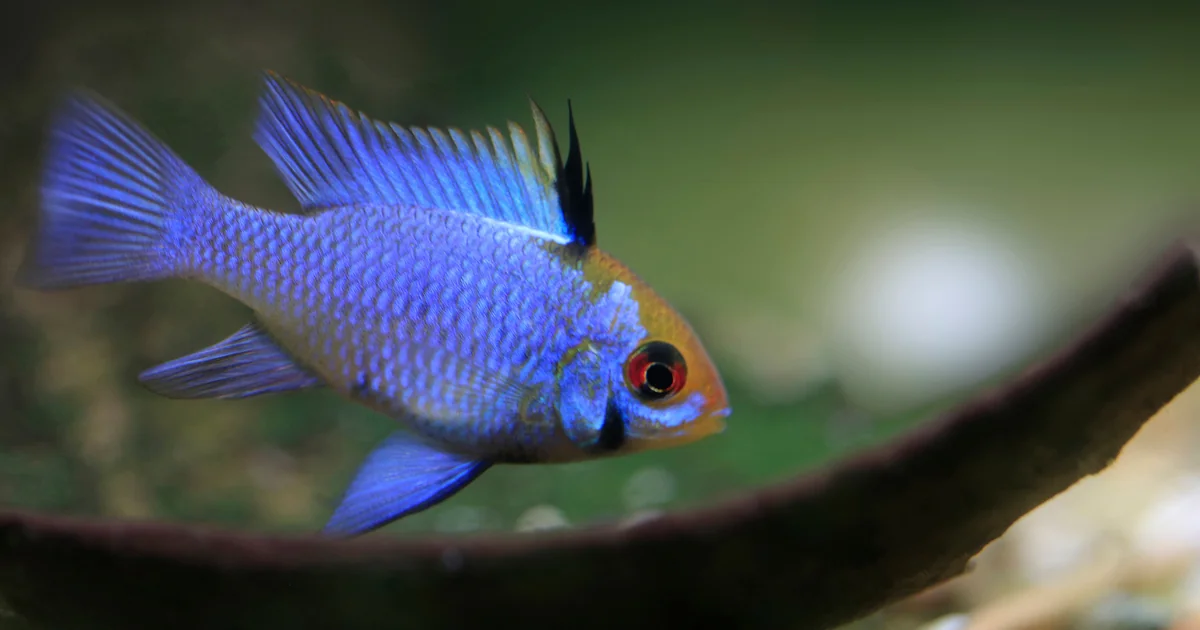
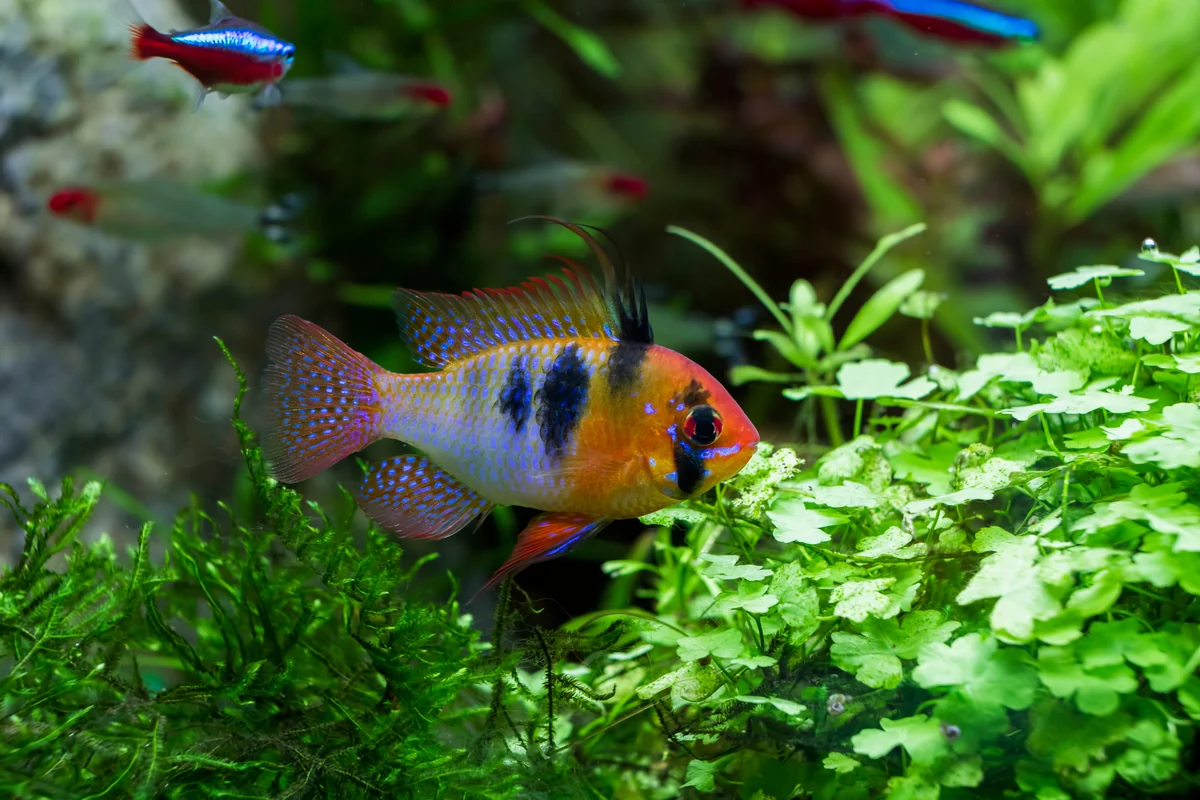
Both ram cichlids share an oval, laterally-compressed body with a slightly upturned snout and large eyes. The German Blue Ram has the more striking color: an iridescent blue body across the flanks, a deep yellow head, red-yellow accent on the dorsal and pelvic fins, and a vertical black bar through the eye. Mature males develop elongated dorsal-fin rays that trail behind the body. The Bolivian Ram is more subtle: yellow-bronze body, red fin highlights, and a thin vertical black bar through the eye. Mature Bolivian males develop somewhat similar dorsal-fin extensions, though less dramatic than the German Blue.
Color morphs (German Blue Ram)
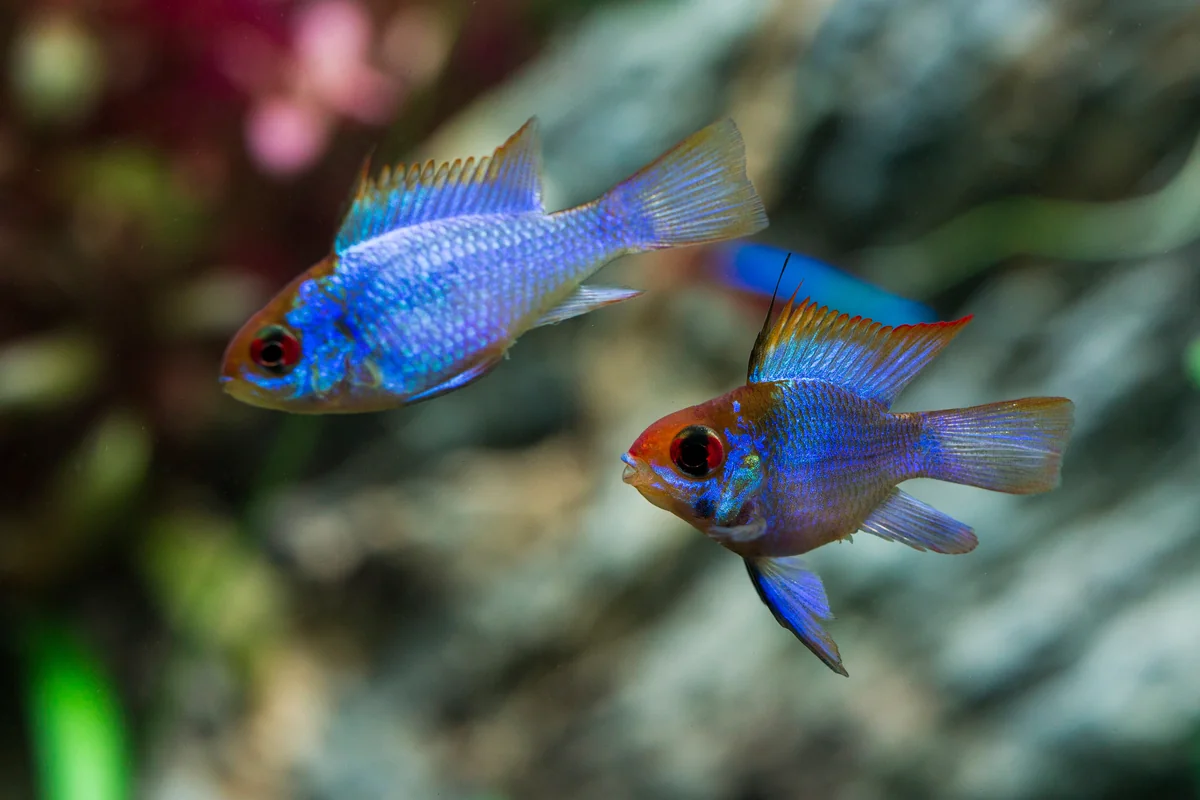 German Blue Rams have been heavily line-bred for color, producing several morphs that vary in availability and hardiness:
- Standard German Blue: classic iridescent blue body. Most widely available.
- Electric Blue Ram: solid bright electric blue across the body. More fragile due to inbreeding.
- Gold Ram: yellow-gold body without the blue. Hardier than electric blue.
- Long-finned Ram: extended fin filaments on otherwise standard color base.
- Balloon Ram: rounder, foreshortened body shape from selective breeding. Considered ethically questionable due to swim-bladder issues.
Bolivian Rams are not line-bred to the same extent and are generally only sold in their natural color form.
Ram cichlid tank size and setup requirements
Tank size
A bonded pair of ram cichlids needs 20 gallons minimum, 30+ if you’re adding community fish. A single ram cichlid in a 20-gallon community tank works fine. Two males in under 40 gallons doesn’t work. They fight over territory until one is killed. The proven group dynamics are: 1 male alone, 1 male + 1 female (pair), or larger groups (4+) in 40+ gallon tanks where a single dominant pair can establish without isolating subordinates.
Use the aquarium volume calculator to confirm your tank’s gallons from dimensions; 20-gallon labels can mean either 20-long (good for rams) or 20-tall (less ideal because of reduced floor space).
Filtration
Ram cichlids prefer low-to-moderate flow. They’re substrate-oriented dwarf cichlids that don’t enjoy strong directional currents. A standard hang-on-back filter or a sponge filter both work well at this tank size. Aim for 5-7× tank turnover per hour. Our best aquarium filters guide covers tank-size matched options.
Heating, and the German Blue heat requirement
German Blue Rams need 78-85°F, which is warmer than most community fish. They’re one of the warmest-water community fish kept in the hobby, alongside discus. This warm-water requirement is one of the major reasons German Blues fail in standard community tanks: the keeper drops them into a 76°F tank that’s fine for tetras and corydoras, and the ram is chronically stressed because it’s 5°F too cool for them. If you can’t or don’t want to run your tank at 80°F+, choose Bolivian Rams instead.
Bolivian Rams thrive in 72-79°F, which overlaps with most standard tropical community tanks. They’re the species you actually want for a “regular” community tank.
Water conditions
German Blue Rams need soft acidic water (pH 5.5-7.0, GH 0-8); RO water with light remineralization is recommended for serious German Blue keepers. They’re sensitive to mineral content and don’t thrive in hard tap water above pH 7.5. Bolivian Rams are dramatically more tolerant: pH 6.0-7.5 and GH up to 15 dGH work fine. Most tap water will work for Bolivians; very few tap water sources work natively for German Blues.
Both species need pristine ammonia and nitrite (0 ppm) and prefer nitrate under 20 ppm. 25% weekly water changes are the standard cadence.
Substrate, decor, and plants
Ram cichlids dig and sift the substrate looking for food, so use sand or fine gravel, never sharp-edged substrate that could damage their slightly extended barbel-like sensory cells around the mouth. Decor should include flat smooth stones (used as spawning surfaces by bonded pairs), driftwood for visual cover, and broad-leaved plants like Amazon Sword or Anubias. Floating plants help dim the light, which both species prefer.
Indian Almond leaves on the substrate add tannins that mimic both species’ native blackwater conditions and have antimicrobial benefits.
What do ram cichlids eat?
Ram cichlids are carnivorous-leaning omnivores. In the wild they sift substrate for small invertebrates and forage near the bottom for insect larvae and crustaceans. Captive feeding should reflect this:
| Food | Type | Notes |
|---|---|---|
| Sinking dwarf cichlid pellets | Daily staple | Hikari Cichlid Bio-Gold mini, Northfin Community formula. Sized for small mouths; sinks for substrate-foraging behavior. |
| Frozen bloodworms, daphnia, brine shrimp | Protein supplement | 3-4× weekly. Highly attractive; supports color and breeding conditioning. |
| Live blackworms or microworms | Premium live food | Excellent for breeding conditioning. Source from cultured suppliers. |
Two small feedings per day. Ram cichlids are slow eaters compared to active mid-water community fish, so use a feeding ring or drop sinking food in a low-flow zone.
For ram cichlids, Hikari Tropical Semi-Floating Micro Pellets are sized for the small dwarf-cichlid mouth and slow-sink so substrate-foraging behavior still pays off (rams pick from the bottom; floating pellets miss them entirely):

Best ram cichlid tank mates (and what to avoid)
| Species | Compatibility | Notes |
|---|---|---|
| Tetras (cardinal, neon, rummynose) | Good | Same parameters and biotope (South American soft-water). Mid-water; different niche from substrate-oriented rams. |
| Corydoras catfish | Good | Bottom-dweller schoolers. Matches South American biotope. Substrate competition is mild. |
| Bristlenose Pleco | Good | Algae cleanup, peaceful, won’t bother rams. |
| Discus (German Blue Ram only) | Good | Classic warm soft acidic biotope pairing. Same parameters; different tank levels. |
| Angelfish | Caution | Both cichlids; possible in 40+ gal. Avoid breeding both species simultaneously to prevent territorial conflict. |
| Other dwarf cichlids (apistogramma) | Caution | Possible in 40+ gal with separate territories. Both species pair-bond and defend turf. |
| Two male rams in <40 gal | Avoid | Will fight until one is killed. Single, pair, or 4+ in larger tanks only. |
| Aggressive cichlids (oscars, jack dempseys) | Avoid | Size and temperament mismatch. |
| Cool-water fish (white clouds, hillstream loaches) | Avoid | Temperature mismatch, especially with German Blue Rams. |
Common ram cichlid diseases and how to treat them
Bolivian Rams are robust. German Blue Rams are notoriously delicate, and most German Blue health issues trace back to either water-quality stress or to the fact that commercial breeding lines are heavily inbred and carry mycobacteriosis (Fish TB) at concerning rates.
| Condition | Symptoms | Treatment |
|---|---|---|
| Mycobacteriosis (Fish TB) | Chronic wasting; raised lesions; especially common in German Blue commercial lines | Essentially incurable. Buy from reputable breeders that outcross or import wild-blood. Quarantine new arrivals 4+ weeks. |
| Ich | White grain spots | Heat 84-86°F (within both species’ range) + Ich-X or salt 0.1-0.2% |
| Hexamita / Hole-in-the-Head | Pitted lesions on head, gradual wasting | Metronidazole in food and water; address underlying water quality. |
| Stress-induced color loss | Faded colors, especially in German Blue Rams | Verify water parameters, dim lighting, add cover. Often the first sign of suboptimal conditions. |
How to breed ram cichlids at home
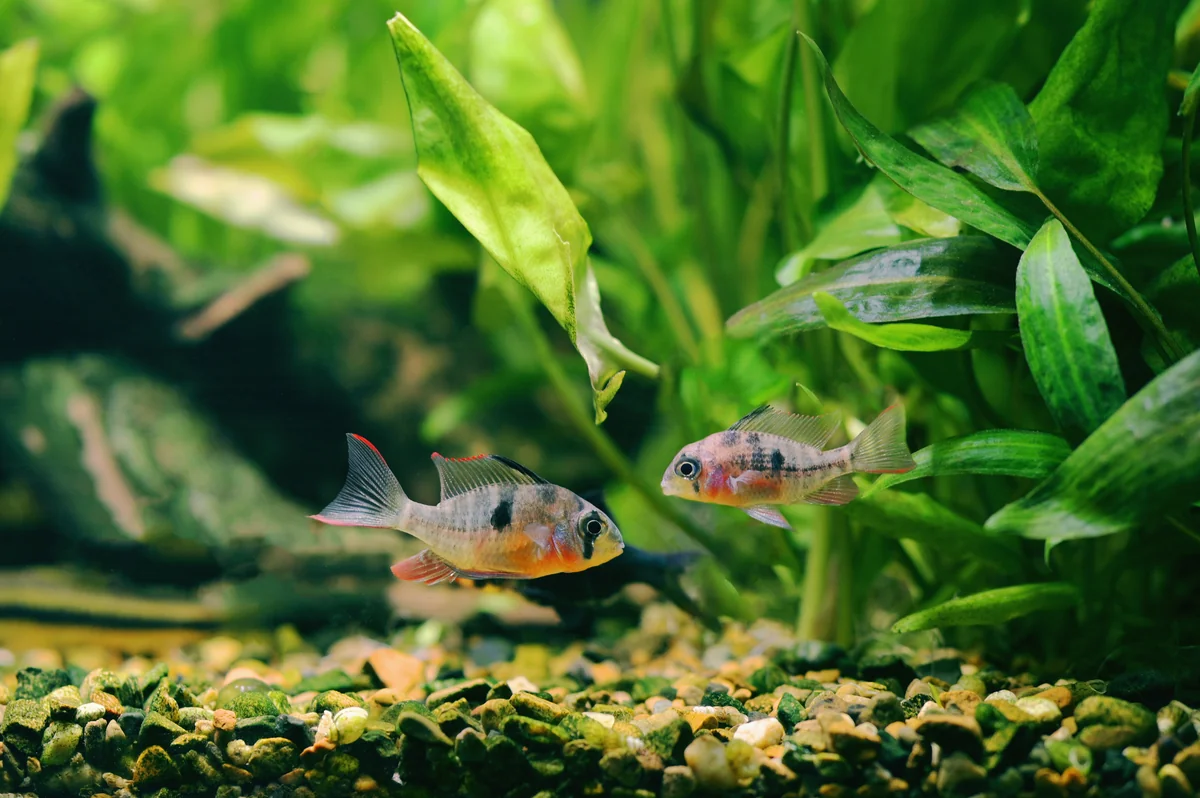 Both ram species are pair-bonding substrate spawners. The breeding sequence is similar: a bonded pair selects a flat smooth surface (slate, broad leaf, or rock), cleans it together, and the female lays eggs in tidy rows. Both parents guard the eggs and fan them with pectoral fins. Eggs hatch in 60-72 hours; fry are free-swimming after another 4-5 days.
To encourage breeding, condition a young pair on protein-rich live foods, raise temperature to the upper end of the species’ range (78-80°F for Bolivian, 82-85°F for German Blue), provide flat spawning surfaces, and dim the lighting slightly. Bolivian pairs are usually reliable parents. German Blue pairs from inbred commercial lines often eat their own eggs from inexperience or stress.
Ram cichlid care FAQs
Are ram cichlids beginner-friendly?
Bolivian Rams yes, German Blue Rams no. Bolivian Rams tolerate a wide pH range, cooler temperatures, and harder water; they handle imperfect water-quality management without dying. German Blue Rams need warm soft acidic water and have shorter lifespans due to commercial-line inbreeding. Start with Bolivian; graduate to German Blue once you have 1-2 years of fishkeeping experience.
Why are German Blue Rams so hard to keep?
Three factors: their narrow water-parameter requirement (warm 78-85°F, soft, acidic), their susceptibility to mycobacteriosis from inbred commercial lines, and the tendency for keepers to put them in standard 76°F community tanks where they’re chronically stressed. Source from a specialty breeder, run the tank at 80°F+, use soft slightly-acidic water, and they’re keepable. Skip any of those and they fade fast.
How long do ram cichlids live?
Bolivian Rams: 4 years typical. German Blue Rams: 2-3 years (limited by inbred commercial lines; wild-blood specimens reach 4 years).
Can I keep ram cichlids with other cichlids?
Yes, with care. Discus is the classic German Blue Ram pairing because parameters match perfectly. Angelfish and apistogramma both work in 40+ gallon tanks if you don’t try to breed both species simultaneously. Avoid larger New World cichlids (oscars, jack dempseys, convicts), which will out-compete and bully rams.
How do I tell male from female ram cichlids?
Males are slightly larger, more colorful, and develop elongated dorsal-fin extensions in maturity. Females are slightly smaller, less colored, and rounder through the abdomen (especially when carrying eggs). Reliable sexing usually requires waiting until the fish is 3+ months old.
Is a ram cichlid right for your tank?
Ram cichlid care is a great entry point to dwarf cichlids if you pick the right species for your setup. Bolivian Rams are hardy, tolerant of typical community-tank parameters, and forgiving of beginner husbandry mistakes. German Blue Rams are more colorful but require dedicated soft-water warm-water setup and careful sourcing to avoid mycobacteriosis-prone commercial lines.
For matched filtration recommendations on a 20-30 gallon ram-cichlid tank, see our best aquarium filters guide. Pair rams with peaceful tetras, corydoras, and a bristlenose pleco in a planted Amazon-style aquascape, and you have a low-maintenance South American biotope tank that runs well for years.