If you’ve watched a hillstream loach pin itself directly in front of your filter output, refusing to leave the strongest current in the tank, you already understand 80% of what hillstream loach care is actually about. Mine lived in that same spot for years. They aren’t lazy. They aren’t stressed. They are doing exactly what their flat, suction-disc body was built to do: cling to rocks in fast-moving Vietnamese mountain streams.
Most aquarium fish you can drop into a standard community tank and tune from there. Hillstream loaches are different. They need cool water, strong flow, and oxygen-rich conditions that resemble the rocky riverbeds they evolved in. Get the setup right and they’re peaceful, hardy, algae-grazing little tank workhorses with a 10-year lifespan. Get it wrong and they’ll fade out in months.
This guide covers exactly how to set up the kind of tank a hillstream loach actually thrives in: the tank size, the filter-flow target, water parameters, group size, what to feed them, which tank mates work, and the most common care mistakes that turn this otherwise hardy species into a casualty.
Disclosure: This post contains affiliate links. If you purchase through a link on this page, we may earn a small commission at no extra cost to you. We only recommend products we’d use in our own tanks.
Quick overview
| Attribute | Detail |
|---|---|
| Common Names | Hillstream loach, Reticulated hillstream loach, Tiger hillstream loach, Borneo loach (the trade often lumps several species under “hillstream loach”) |
| Scientific Name | Sewellia lineolata (the most commonly traded species; see varieties table for related species) |
| Family | Balitoridae (hillstream loaches and stone loaches) |
| Origin | Fast-flowing rocky mountain streams of Vietnam (Sewellia); related species native to Borneo, China, and southeast Asia |
| Adult Size | 2.5 inches (6 cm) |
| Lifespan | 8-10 years in well-maintained tanks |
| Tank Size | 30 gallons minimum for a group of 3 or more |
| Temperature | 65-75°F (18-24°C). NOT a tropical fish. Sustained temperatures above 78°F cause stress and oxygen problems. |
| pH | 6.5-7.5 |
| Temperament | Peaceful with most fish; mild territoriality with conspecifics over feeding spots |
| Diet | Omnivore leaning herbivore. Biofilm, soft algae, sinking veggie foods, occasional protein |
| Care Level | Moderate. Hardy once setup is right; the setup itself is the hard part. |
Appearance
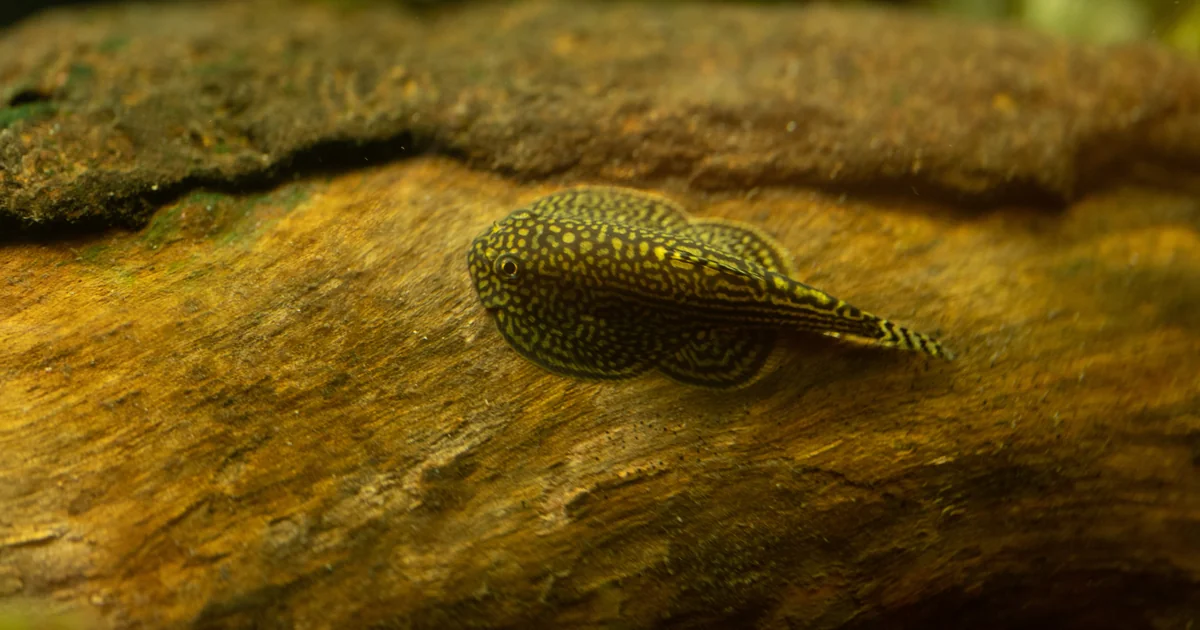
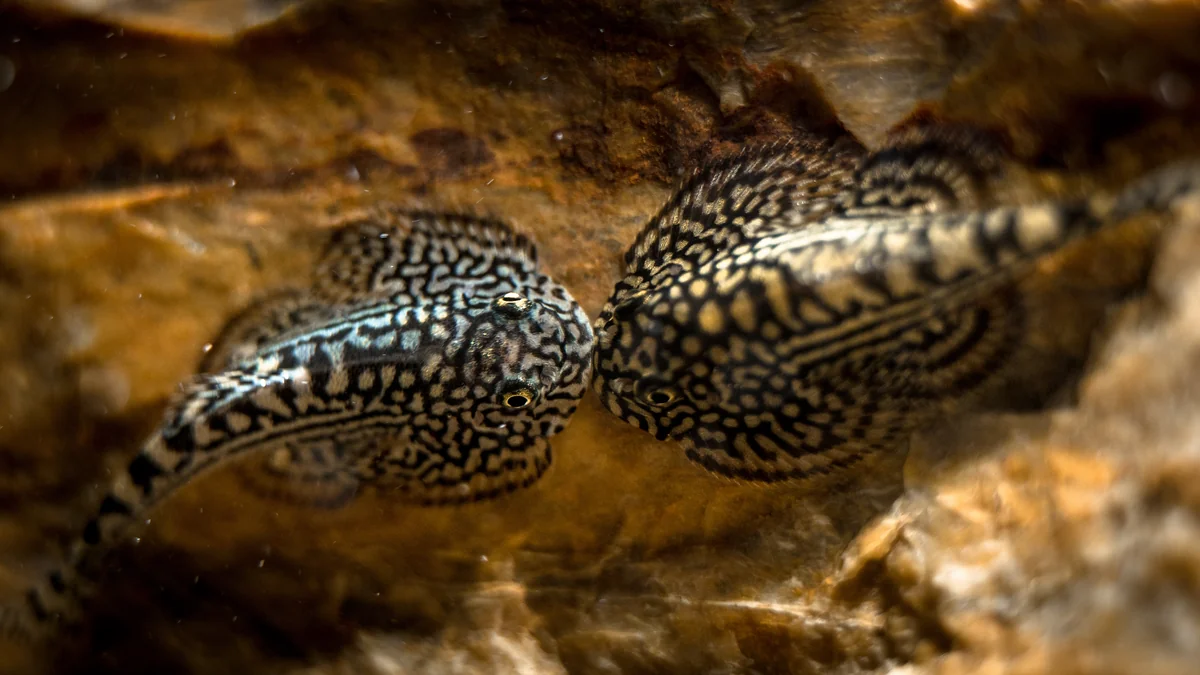
A hillstream loach looks like a flat, oval-bodied stingray that someone shrunk down and gave a fishy tail. The body is dorso-ventrally compressed, almost coin-shaped from the side, with pectoral and pelvic fins extended outward to form a continuous suction-disc surface on the underside. That whole flat belly works like a foot, letting them hold position on glass or rock against current strong enough to push around most other fish.
Color and pattern in Sewellia lineolata is a yellow-on-dark-olive reticulated pattern, roughly resembling a labyrinth or fingerprint. Pattern density and contrast vary between individuals, and well-fed fish on a varied diet show the brightest yellow. The eyes sit on top of the head rather than the sides, which is the giveaway that this is a benthic ambush-feeder built to look up from the substrate.
The suction-disc anatomy is where the magic is

If you can get a hillstream loach to climb the front glass, take a moment to look at the underside through the pane. The body is essentially flat, with the pectoral and pelvic fins forming an unbroken oval ring around a central white belly. The mouth is small, set well back from the body’s leading edge, and the gills sit recessed underneath. There’s no traditional “fish-shaped” silhouette under there at all. They are evolved to function as a living suction cup. This is also why they can scoot up the side of an aquarium effortlessly while corys and otos struggle.
Sexual dimorphism
Sexing hillstream loaches is subtle. Mature males develop slightly thicker, more lobed pectoral fins with raised tubercles along the leading edge, while females tend to be a bit broader through the belly when carrying eggs. In a typical store group of juveniles, sex is essentially impossible to determine. If you want a breeding group, buy 6-8 young fish and let them sort it out as they mature.
Hillstream loach varieties commonly sold
“Hillstream loach” in the trade often covers multiple genera. They share similar care needs but differ in pattern and adult size:
| Variety | Description |
|---|---|
| Reticulated Hillstream Loach (Sewellia lineolata) | The most common in the hobby. Yellow reticulated pattern on olive body. Vietnam native. Adults around 2.5 in. |
| Tiger Hillstream Loach (Sewellia sp. SEW01) | Bolder dark vertical bands rather than fine reticulation. Same care as S. lineolata. |
| Borneo Loach / Borneo Sucker (Gastromyzon spp.) | Darker, more uniformly spotted. Slightly larger. Native to Borneo. Often confused with hillstream loaches at the LFS. |
| Chinese Hillstream Loach (Beaufortia kweichowensis) | Slightly larger (3 in), greener body, broad fan-shaped fins. Care is similar but tolerates a wider temperature range. |
| Spotted Hillstream Loach (Sewellia spp. variants) | Larger spotted pattern variants of Sewellia. Identification varies by importer; care needs match the genus. |
If a fish store labels something simply as “hillstream loach,” ask what species it is, or look at pattern and origin. The care advice below applies cleanly to Sewellia and Gastromyzon; Beaufortia tolerates slightly wider parameters but is happiest under the same conditions.
Tank setup
A hillstream loach tank is essentially a river biotope. The single biggest mistake I see in hillstream loach care is treating them like a community algae-eater and dropping them into a still, warm 78°F planted tank. They will hang on for a few months and then quietly fade. Built right, the tank is genuinely easy to maintain.
Tank size
Minimum 30 gallons for a group of 3-4 hillstream loaches. They’re small (2.5 inches) so the size requirement isn’t about adult dimensions, it’s about water volume needed to dissipate the heat from a strong filter and powerhead, and the floor space needed to give multiple fish their own grazing rocks without constant skirmishing. A 40-gallon breeder (longer and lower than a standard 40) is the genuine sweet spot. Larger groups (6-8) want 55+ gallons.
Tank shape matters more than gallons. Long, low tanks (30 long, 40 breeder, 55 standard) outperform tall narrow tanks because hillstream loaches use floor area, not height. If you’re not sure how many gallons your tank actually holds, our aquarium volume calculator will give you the real number from the dimensions.
Filtration and flow
This is the section that matters most. Hillstream loaches need flow rates roughly double what a typical community tank uses, and they need it across a meaningful section of the tank rather than just dribbled out from one corner.
Target: 15-20× tank volume per hour total turnover, vs the standard 5-10× community-tank rule. For a 30-gallon tank, that’s 450-600 GPH delivered to the water column. The cleanest way to hit that number is a canister filter combined with a small powerhead at the opposite end. Our roundup of the best canister filters covers models that handle this load without becoming a maintenance burden, and the best aquarium filters guide compares HOB-plus-powerhead approaches if you’re working with a smaller setup.
From personal experience, my own hillstream loaches consistently positioned themselves directly in the filter output flow, often pinning themselves to the glass right under the spillway or in front of the canister return. They aren’t avoiding the rest of the tank. They’re choosing the highest-flow zone because that’s where the water is most oxygenated and where the rheophilic stress response that keeps them healthy is satisfied. If your hillstream loach is hugging the substrate in a low-flow zone, the flow probably isn’t strong enough.
Heating (or rather, not heating)
Hillstream loaches are coolwater fish. The 65-75°F sweet spot sits below most homes’ ambient indoor temperature in summer. In most climates and most rooms a heater is unnecessary and may even be counterproductive. If your tank is in a cool basement or unheated room and the temperature drops below 62°F in winter, a heater set to 68°F for stability is fine. Otherwise, skip it.
Summer is the harder season. If your tank trends above 78°F, you need to lower the temperature: a clip-on cooling fan blowing across the surface drops temp 2-4°F via evaporative cooling, ice-bottle floats are an emergency backup, and an inline aquarium chiller is the high-end fix for warmer climates. Sustained 80°F+ kills hillstream loaches faster than almost any other condition.
Water conditions
| Parameter | Target |
|---|---|
| Temperature | 65-75°F (18-24°C); ideal 68-72°F |
| pH | 6.5-7.5 |
| GH | 5-15 dGH |
| KH | 3-8 dKH |
| Ammonia | 0 ppm always |
| Nitrite | 0 ppm always |
| Nitrate | <20 ppm (they tolerate higher but algae growth, their natural food source, suffers above this) |
| Dissolved oxygen | High. Surface agitation from filter return is your main lever. |
Hillstream loaches are sensitive to ammonia and nitrite, more so than many tropicals. Cycle the tank thoroughly before adding them, and target nitrate under 20 ppm with weekly 25-30% water changes. Soft-to-moderate hardness suits them best; very soft tanks (under 5 dGH) are a stretch but workable if KH stabilizes the pH.
Substrate, decor, and lighting
Aquascape the tank as a stream bed: smooth river rocks of varied sizes, smooth driftwood pieces, and a substrate that won’t get blown around by 600 GPH of flow. Sand or fine gravel works for the substrate as long as you don’t aim a powerhead directly down at it. Smooth river rocks are essential because they’re the actual surface hillstream loaches graze on, and the broader, flatter ones give them ledges to camp on.
Lighting can be moderate to strong. The bright light supports algae and biofilm growth on the rocks, which is exactly what you want as their primary food source. Don’t run a deeply shaded planted tank for hillstream loaches; you’ll be feeding them artificial food forever instead of letting them graze the way they naturally do.
Plants are fine but optional. Java fern, Anubias, and mosses tolerate the high flow and don’t need root substrate access. Stem plants will struggle to stay anchored. Floating plants help diffuse light and add cover, though strong surface flow may push them around.
Diet and feeding
Hillstream loaches are biofilm and soft-algae grazers in the wild. In a properly set up tank with smooth rocks under decent light, they’ll get most of their nutrition by grazing the surfaces. That said, captive tanks rarely produce enough algae to support multiple hillstream loaches indefinitely, so supplemental feeding is required.
Recommended foods
| Food | Type | Notes |
|---|---|---|
| Hikari Algae Wafers | Sinking herbivore staple | The standard. Drop one wafer per 2-3 fish every other day. Place near a flat rock so they can claim it. |
| Repashy Soilent Green | Gel diet, herbivore | Mix powder with hot water, smear on a flat rock or feeder dish, refrigerate. Excellent for hillstream loaches; they love it. |
| Blanched zucchini, cucumber, spinach | Fresh vegetable | Skewer with a veggie clip and anchor near a high-flow zone. Remove leftover after 12 hours. |
| Frozen bloodworms or daphnia | Protein supplement | Once or twice a week. Small portions; they’re not heavy carnivores. Adults love it during conditioning for breeding. |
| Crushed Repashy Soilent Green pellets or sinking shrimp pellets | Sinking pellet | Useful for tanks with stronger competition for food (e.g. shrimp present). |
For sinking algae wafers, is the standard recommendation and what most hillstream keepers settle on.
How much, how often
Adult hillstream loaches in a tank with grazeable algae need supplemental food only every other day. In a sterile, algae-free setup, daily small feedings work better. Watch belly fullness: well-fed fish are slightly rounded; concave bellies mean underfed; bloated bellies mean overfed.
Tank mates
Hillstream loaches are peaceful with everything except similarly-shaped competitors. The constraint isn’t temperament. It’s matching the cool, high-flow, oxygen-rich environment they need. Most “compatible” species lists you’ll see online include warm-water tropicals (Endlers, mollies, corydoras) that don’t actually thrive at hillstream parameters.
Compatibility table
| Species | Compatibility | Notes |
|---|---|---|
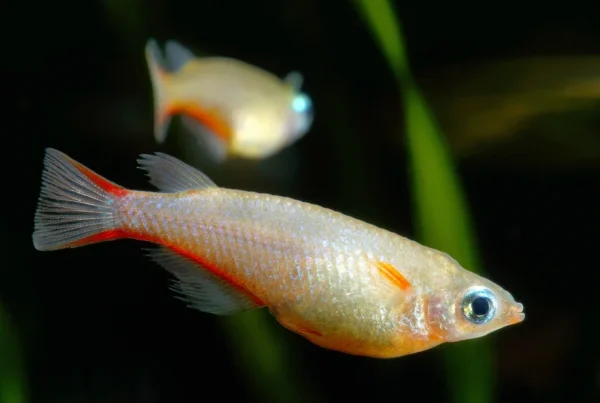
| White Cloud Mountain Minnow | Good | Cool-water schooling fish. Same temperature preferences. Active mid-water occupant that fills out the tank visually. |
| Other Hillstream Loaches (same species) | Good | Keep 3+ minimum. They form loose social groups, mild territoriality at feeding spots is normal. |
| Amano Shrimp | Good | Tolerate cool water. Excellent algae cleanup partner. Won’t compete much with hillstreams for grazing surfaces. |
| Cherry Shrimp | Good | Cool-tolerant. Adults safe; tiny shrimplets occasionally consumed but colony will thrive. |
| Zebra Danios | Good | Cool-tolerant, active schoolers, enjoy strong flow. Classic hillstream tankmate. |
| Pearl Danios / Celestial Pearl Danios | Good | Cool tolerant; small schooling fish that won’t outcompete loaches at feeding time. |
| Corydoras (Panda, Sterba’s) | Caution | Coldwater corys (Panda) overlap. Most other corys prefer 76°F+, too warm for hillstreams. Match species carefully. |
| Otocinclus | Caution | Direct algae-grazing competition. Small tanks won’t have enough biofilm for both. OK in 40+ gallons with abundant rocks. |
| Bettas, Gouramis, Angelfish | Avoid | Tropical species needing 78-82°F. Goes straight against the hillstream’s coolwater requirement. |
| Mollies, Endlers, Platys | Avoid | Live-bearers thrive at 76-82°F and prefer harder, warmer water. Wrong tank profile entirely. |
| Goldfish | Avoid | Bioload mismatch even if temperature aligns. Goldfish disturb substrate, eat smaller tankmates, and produce waste at rates that overwhelm small loach setups. |
| Aggressive cichlids | Avoid | Hillstreams are slow and exposed when grazing. Easy targets for aggressive territorial species. |
Health
Signs of a healthy hillstream loach
A healthy hillstream loach is active, bright in color, with a slightly rounded belly and clear unclouded eyes. They should regularly leave the substrate to graze rocks or scoot up the front glass for biofilm. The most reliable indicator: they hold themselves confidently in the strongest flow zone of the tank rather than hiding behind decor. Lethargic fish that drift to low-flow zones, stop grazing, or develop concave bellies are showing early signs of stress or illness.
Common diseases
| Condition | Symptoms | Treatment |
|---|---|---|
| Ich (white spot) | White grain-of-salt spots on body and fins; flashing against rocks | Salt at 0.2-0.3% concentration for 7-10 days. Do NOT raise temperature above 78°F (will stress the fish more than ich). |
| Internal parasites | Wasting despite eating; thin bodies in wild-caught specimens | Praziquantel-based dewormer (PraziPro) for 5-7 days. Common in newly imported wild-caught hillstreams; quarantine all new arrivals. |
| Heat stress / oxygen deficiency | Gasping at surface, lethargy, refusal to graze; usually summer | Drop temperature using a clip-on fan, increase surface agitation, and consider a chiller for warm climates. Often fatal if not addressed within 48 hours. |
| Fungal infection | White cottony growth on skin or fins; secondary to physical damage or stress | Methylene blue at 2-3 ppm or salt at 0.2-0.3%. Avoid copper-based fungal medications; loaches and many scaleless or thin-scaled fish are sensitive. |
| Starvation | Concave belly, sluggish behavior, eventually emaciation | Very common in tanks without algae growth or with food competition. Increase frequency of sinking algae wafers and Repashy gel; use a feeding dish in a low-traffic spot. |
Prevention
Most hillstream loach health problems trace back to environment, not pathogens. Cool stable temperature, strong flow, oxygen-rich water, and adequate food cover most of the prevention bases. Quarantine all new arrivals for 2-4 weeks before introducing to a display tank: most retail hillstream loaches are wild-caught and frequently carry internal parasites that don’t show symptoms until the fish is settled and stressed.
Breeding
Hillstream loaches are bred in captivity but it’s not common, and most fish in the trade are wild-caught from Vietnam. The basic protocol involves a well-conditioned mature group (6+ fish), strong flow simulating the rainy-season swell, plenty of smooth flat rocks for spawning surfaces, and a temperature drop followed by a temperature rise to mimic seasonal cues. Eggs are scattered onto rocks; fry are tiny and require infusoria or finely-powdered foods until they’re large enough for crushed algae wafers.
If you want to attempt breeding, start with 6-8 fish in a dedicated 40+ gallon tank, condition them on a varied diet (live blackworms, daphnia, gel diet), and study the work of breeders like Mark Duffill (Practical Fishkeeping) who have documented successful spawns. Casual hobbyist breeding is rare enough that successful spawns are still considered notable.
Frequently asked questions
Can hillstream loaches live in a community tank?
Yes, but only with cool-water community species like White Cloud Mountain Minnows, danios, Amano shrimp, and Pearl Danios. Standard tropical communities (mollies, tetras, gouramis) run too warm and have wrong-niche tank mates. The community tank has to be built around the hillstream loach’s temperature and flow needs, not the other way around.
How many hillstream loaches should I keep together?
Three minimum, six or more ideal. They’re loosely social and a single hillstream loach in a tank tends to hide and stop grazing. Groups develop a relaxed dynamic with low-level squabbling over feeding rocks but no real fighting. A 30-gallon tank handles 3-4; 40+ gallons supports 6-8.
Do hillstream loaches need a heater?
In most homes, no. Their preferred range (65-75°F) sits within typical indoor ambient temperature. A heater is only useful if the tank is in a cool basement that drops below 62°F in winter. The bigger summer concern is keeping the tank from getting too warm; sustained 80°F+ can kill them.
Why does my hillstream loach sit in front of the filter output?
Because that’s the highest-flow, most oxygenated zone in the tank, and that’s the environment they evolved in. They aren’t stressed or trapped. They’re content. If anything, hillstream loaches that don’t camp in the strongest flow zone are signaling that the flow isn’t strong enough to satisfy their natural rheophilic instincts. My own group spent years parked directly under the canister return.
Will hillstream loaches eat all my algae?
Soft green algae and biofilm, yes. Hair algae, black beard algae, and tougher growths, mostly no. They’re efficient grazers on the algae types they evolved to eat (diatoms, soft greens) but they’re not a complete algae solution. For nuisance algae control you still need to address the underlying cause (light intensity, photoperiod, nutrient levels). Hillstream loaches are an algae-eating bonus, not the algae fix.
How long do hillstream loaches live?
8-10 years in well-maintained tanks. They’re a long-term investment, not a quick add. The setup commitment pays off because once the tank is dialed in correctly, they’re remarkably hardy and trouble-free.
Final thoughts
Hillstream loach care comes down to three commitments: cool water (65-75°F), strong flow (15-20× turnover), and a small social group of at least three. Get those right and the rest is detail. Get any of them wrong and you’ll be replacing fish in months. The gear you’ll lean on most is filtration, so it’s worth investing in a quality canister filter or a strong HOB plus powerhead combination from the best canister filters roundup or the best aquarium filters guide.
Build the tank as a Vietnamese stream rather than a community planted display, pair them with cool-tolerant tank mates like the White Cloud Mountain Minnow, and feed them sinking algae wafers plus the occasional gel diet treat. The reward is a tank full of charismatic, suction-cup little oddballs that camp in the current and quietly clean your rocks for the next decade.