Pearl gourami care is straightforward, the fish are hardy, and they’re one of the few gouramis that haven’t been wrecked by selective breeding. If you’ve heard the warnings about Dwarf Gourami Iridovirus (DGIV) decimating dwarf gourami populations and you’re wondering which gourami to actually buy, the pearl gourami (Trichopodus leerii) is usually the right answer. They’re larger (4-5 inches), live longer (5-8 years), and aren’t affected by the disease that’s been killing pet-store dwarf gouramis at high rates.
Pearl gouramis are also genuinely beautiful in a way that doesn’t show up at the fish store. Juveniles are subtle silver-tan with mottled spots, but mature males develop a deep orange-red throat, filamentous trailing pelvic fins, and an iridescent pearl-like body sheen that earns the species its name. They’re peaceful community fish that work in a wide range of standard tropical setups, with one important exception: they will eat your cherry shrimp. This guide covers everything pearl gourami care actually needs.
Disclosure: This post contains affiliate links. If you purchase through a link on this page, we may earn a small commission at no extra cost to you. We only recommend products we’d use in our own tanks.
Pearl gourami care at a glance
| Attribute | Detail |
|---|---|
| Common Names | Pearl gourami, Lace gourami, Mosaic gourami, Diamond gourami |
| Scientific Name | Trichopodus leerii |
| Family | Osphronemidae (gouramis); subfamily Luciocephalinae |
| Origin | Thailand, Malaysia, Indonesia (peat-stained lowland swamps) |
| Adult Size | 4-5 inches (10-12 cm) |
| Lifespan | 5-8 years |
| Tank Size | 30 gallons minimum for one; 40+ for a pair or community |
| Temperature | 75-82°F (24-28°C); ideal 78°F |
| pH | 6.0-7.5 (broadly tolerant) |
| Temperament | Peaceful and community-friendly. Mild male-on-male territoriality during breeding. |
| Diet | Omnivore. Flake or pellet base, supplemented with frozen and live foods. |
| Care Level | Easy. One of the easiest “showpiece” community fish to keep. |
What pearl gouramis look like (and how to sex them)
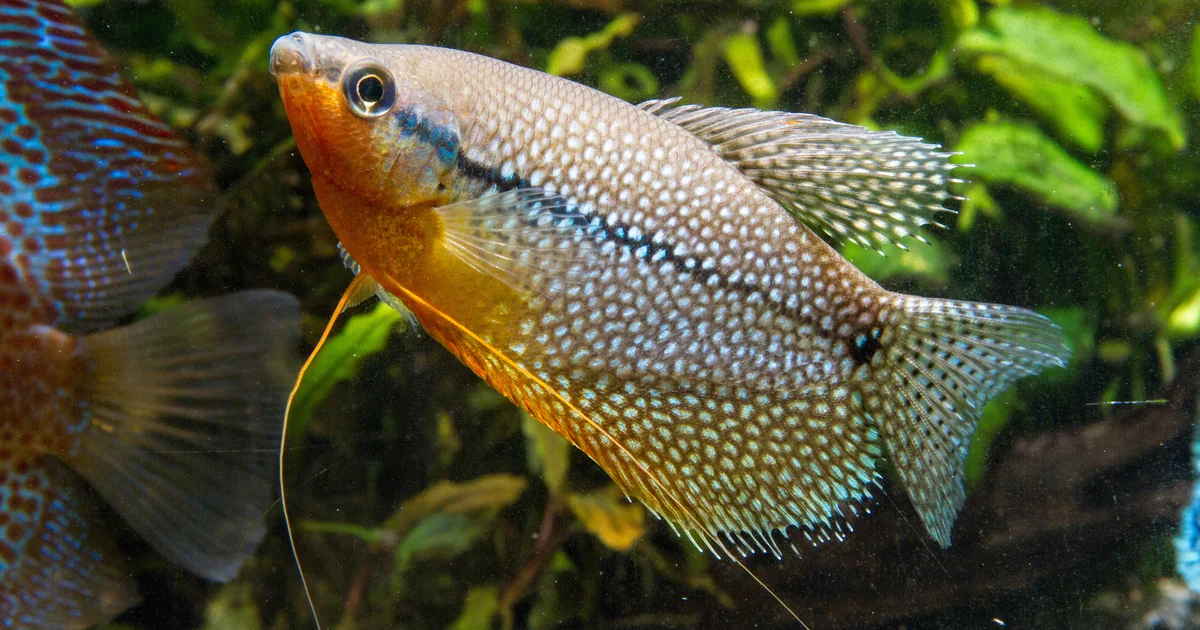
Pearl gouramis have an oval, laterally-compressed body covered in tiny iridescent pearlescent spots that catch the light from any angle. The base color is silvery-tan with a subtle horizontal black band running from the eye to the caudal fin. The trailing pelvic fins are long thread-like filaments that pearl gouramis use as touch-sensors, gently exploring their environment by reaching forward to feel surfaces and other fish.
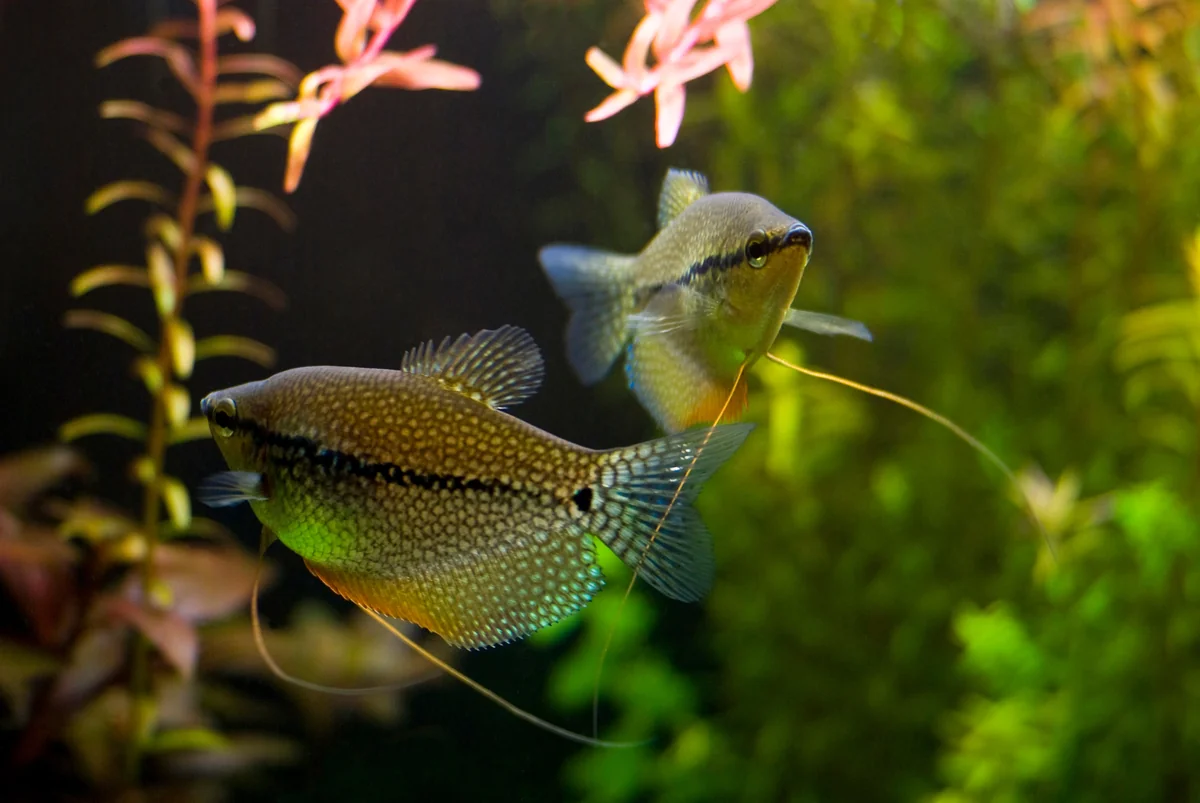
Mature males develop a striking deep orange-red coloration on the throat, chest, and the underside of the head. The dorsal fin elongates into a flowing point, and the anal fin develops similarly elaborate filamentous extensions. Females stay smaller, more subdued in color (silver with the pearl pattern but no red), and rounder through the abdomen.
Sexing pearl gouramis
Mature pearl gouramis are easier to sex than most aquarium species:
- Males: deep orange-red throat and chest; longer pointed dorsal fin; longer anal-fin filaments; slightly more streamlined body.
- Females: silvery-pearl body without red coloration; rounder through the abdomen; shorter, more rounded dorsal fin.
Juveniles are difficult to sex. Wait until 3-4 inches before counting on visual sex identification. Color development happens slowly between months 6 and 12.
Pearl gourami vs dwarf gourami: why this matters
Dwarf gouramis (Trichogaster lalius) are smaller and more colorful at the pet store. They look like the obvious gourami choice for a community tank. They aren’t, and the reason is Dwarf Gourami Iridovirus (DGIV), a viral disease endemic in commercial dwarf gourami breeding lines. Reports vary, but estimates suggest 20-50% of pet-store dwarf gouramis carry the virus, which usually kills them within a year regardless of tank conditions.
Pearl gouramis are not affected by DGIV. They’re larger, more peaceful, longer-lived, and have a flowing-fin display that ultimately surpasses the static color saturation of a dwarf gourami once mature. For most keepers asking “which gourami should I get for my community tank?” pearl gourami is the better answer, and the reasoning is largely about avoiding a disease problem rather than any gourami-vs-gourami showdown.
Pearl gourami tank size and setup requirements
Tank size
30 gallons minimum for a single pearl gourami; 40+ gallons for a pair or community tank. Pearl gouramis use the upper third of the water column (they’re labyrinth fish that breathe air at the surface) so tank length matters more than depth. A 30-long or 40-breeder is ideal. Use the aquarium volume calculator to confirm your tank’s actual gallons before stocking.
Filtration and flow
Pearl gouramis prefer low to moderate flow. Aim for 5-7× tank turnover with the filter return positioned to spread flow gently across the surface. Pearl gouramis are surface-breathers and dislike strong directional currents that disrupt the air-water interface. A standard hang-on-back filter with the output toward a wall or a sponge filter both work well. See our best aquarium filters guide for tank-size matched options.
Heating and water conditions
| Parameter | Target |
|---|---|
| Temperature | 75-82°F (24-28°C); ideal 78°F |
| pH | 6.0-7.5 |
| GH | 2-18 dGH (one of the most flexible gouramis) |
| Ammonia / Nitrite | 0 ppm always |
| Nitrate | <30 ppm |
Pearl gouramis tolerate a wider parameter range than most community fish, which is why they’re so beginner-friendly. Stable parameters matter more than hitting any specific number within the range.
Substrate, decor, and plants
Native pearl gouramis come from peat-stained lowland swamps, so a tannin-tinted, dimly-lit setup with plenty of plants is ideal. Driftwood that releases tannins (Indian Almond leaves, Malaysian driftwood) creates the soft acidic water they prefer. Floating plants are highly recommended: pearl gouramis prefer dappled light and feel exposed under bright open tank lighting. Frogbit, Salvinia, or Water Lettuce all work.
Plants in the tank itself help establish security. Tall background plants (Vallisneria, jungle Val) and broad-leaved midground plants (Amazon Sword, Cryptocoryne) provide the kind of visual cover pearl gouramis use to stay relaxed. A bare tank or sparsely-decorated setup makes them skittish.
What do pearl gouramis eat?
Pearl gouramis are omnivores that thrive on a varied diet. They aren’t picky and accept almost anything offered.
| Food | Type | Notes |
|---|---|---|
| Tropical community flake | Daily staple | Quality flake (Tetra TropiPet, Hikari Bio-Pure) or small slow-sinking pellet |
| Frozen bloodworms, brine shrimp, daphnia | Protein supplement | 2-3× weekly. Especially valuable during male color development and breeding conditioning. |
| Live insect larvae, mosquito larvae | Premium live food | Outdoor-collected live mosquito larvae are a natural prey item; use cautiously and avoid wild-collected from contaminated sources. |
| Spirulina or vegetable flake | Plant supplement | Once or twice weekly to provide vegetable matter. Pearl gouramis nibble soft algae from plant leaves naturally. |
Two small feedings per day is the standard schedule. Pearl gouramis are slow, deliberate eaters, so make sure flake floats long enough for them to eat at the surface (their preferred feeding zone) before sinking past their reach.
For pearl gouramis, Hikari Tropical Semi-Floating Micro Pellets are sized for their small mouth and stay near the surface long enough for slow surface-feeders to eat, then sink past the upper water column rather than blowing past:

Best pearl gourami tank mates (and what to avoid)
| Species | Compatibility | Notes |
|---|---|---|
| Tetras (neon, cardinal, rummynose) | Good | Same parameters, different water level (mid). Classic community pairing. |
| Rasboras (harlequin, lambchop) | Good | Peaceful schooler at similar size. Excellent companion. |
| Corydoras catfish | Good | Bottom-dweller; different niche; sturdy enough to ignore. |
| Honey Gourami | Good | Peaceful smaller gourami. Watch males during breeding but generally compatible. |
| Other Pearl Gouramis | Good | 1 male + 2-3 females ideal. Multiple males in 40+ gal with sight-breaks works. |
| Bristlenose Pleco | Good | Algae cleanup, peaceful, different niche. |
| Tiger Barbs | Caution | Notorious fin-nippers; pearl gourami trailing fins are tempting targets. Possible only in 8+ groups in 40+ gal. |
| Bettas | Caution | Both anabantoids; possible in large planted tanks but male-on-male display can escalate. Skip in <30 gal. |
| Dwarf shrimp (cherry, blue velvet) | Avoid | Pearl gouramis WILL eat dwarf shrimp. Adult Amano shrimp may survive but small Neocaridina won’t. |
| Aggressive cichlids | Avoid | Will harass pearl gouramis off the surface and out of feeding access. |
| Goldfish | Avoid | Cool-water mismatch. Goldfish 64-75°F, pearl gouramis 75-82°F. |
Common pearl gourami diseases and how to treat them
Pearl gouramis are among the hardier community fish. Healthy specimens swim deliberately near the upper third of the tank, surface periodically for air, hold elaborate fin filaments fully extended, and show clear iridescent patterning. Lethargy, clamped fins, hiding behind decor, or refusal to surface for air are warning signs.
| Condition | Symptoms | Treatment |
|---|---|---|
| Ich | White grain spots; flashing | Heat 84°F + Ich-X or salt 0.1-0.2%, 7-10 days |
| Fin rot | Tattered fin edges; especially the long filaments | Improve water quality; remove fin-nippers; antibiotics for severe cases. |
| Fungal infection | Cottony white growths on damaged tissue | Methylene blue 2-3 ppm or salt 0.1-0.2%. Address underlying water quality. |
| Internal parasites | Wasting; stringy white feces | PraziPro + metronidazole; quarantine new arrivals. |
How to breed pearl gouramis at home
Pearl gouramis are bubble-nest builders. Mature males construct elaborate floating bubble nests using saliva-bound air pockets, often anchored to floating plants. The breeding sequence: condition a pair on protein-rich live or frozen foods, raise temperature to 80-82°F, lower water level slightly to encourage surface activity, and provide floating plants. The male builds the nest, courts the female with display dancing, and the pair embraces under the nest in a spawning loop. Eggs float into the nest where the male catches and arranges them.
After spawning, remove the female immediately. The male becomes intensely territorial defending the nest and will harass her. The male tends the eggs and fry until fry are free-swimming (about 4-5 days). Move the male out at that point. Fry are tiny and need infusoria or commercial liquid fry food until they’re large enough for crushed flake or baby brine shrimp.
Pearl gourami care FAQs
How big do pearl gouramis get?
Adult pearl gouramis reach 4-5 inches (10-12 cm). Males are slightly larger and develop the more elaborate fin filaments and red throat coloration.
Can pearl gouramis live with bettas?
Sometimes. Both are anabantoids that breathe air at the surface, which means they share a niche and can compete. In a large planted tank (40+ gallons) with abundant cover, the pairing often works. In smaller tanks, expect either the betta to flare repeatedly at the gourami or the gourami to bully the betta off the surface. Skip the combination in tanks under 30 gallons.
Are pearl gouramis aggressive?
Generally no. They’re peaceful community fish. The exception is male-on-male display behavior during breeding, which can escalate in undersized tanks (under 40 gallons with multiple males). One male and 2-3 females is the safest stocking pattern.
Do pearl gouramis need a heater?
Yes. They’re tropical fish from Southeast Asia and require 75-82°F. Most home indoor temperatures fall below this range, so a heater is mandatory.
Pearl gourami vs dwarf gourami: which should I get?
Pearl gourami in almost all cases. Pearl gouramis are not affected by Dwarf Gourami Iridovirus (DGIV), which kills 20-50% of pet-store dwarf gouramis within their first year. Pearls are also larger, longer-lived, and have a more striking display once mature. Dwarf gouramis only win on initial color saturation at the pet store.
Is a pearl gourami right for your tank?
Pearl gourami care is uncomplicated, the species is hardy and beautiful, and they’re the gourami most beginners should buy instead of dwarf gouramis. The combination of broad parameter tolerance, peaceful temperament, striking adult coloration, and DGIV-free status makes them one of the easier “showpiece” community fish to keep. The only ongoing care item to plan for is a tank stable at 30+ gallons with planted cover, moderate flow, and a few floating plants on the surface.
For matched filtration recommendations on a community tank this size, see our best aquarium filters guide. Pair pearl gouramis with peaceful tetras or rasboras for a relaxed Southeast-Asian-leaning community tank, and you have a setup that runs well for years.