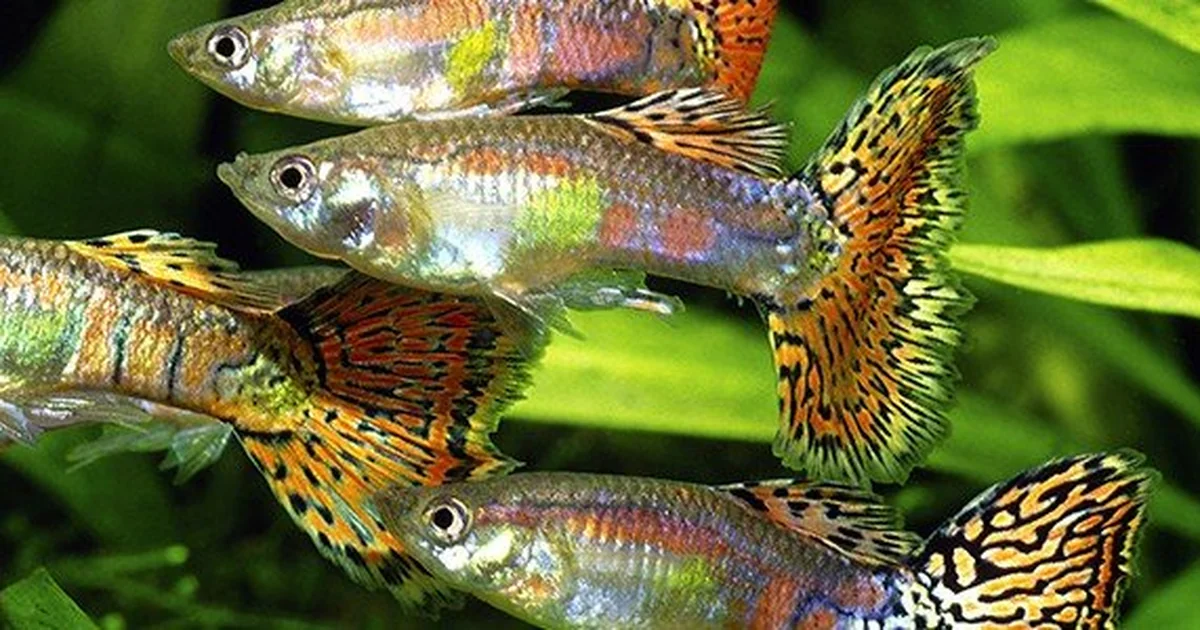
If you’ve been Googling “are guppies schooling fish” because your single guppy is hiding in the corner and refusing to eat, the short answer is: guppies aren’t true schooling fish, but they absolutely need company. The distinction matters more than it sounds, because it changes exactly how you stock your tank.
Guppies are shoaling fish. That means they group together loosely for social contact and security, but they don’t swim in the tight, synchronized formations you see with rummy nose tetras or cardinal tetras. Understanding that difference is what makes beginner guppy stocking go right or wrong, and it leads directly to three practical rules: keep at least 5–6, follow a 1 male to 2–3 females ratio, and start with no less than 10 gallons.
This article unpacks each of those rules and explains the biology behind them. For the full picture of guppy husbandry, our full guppy care guide covers everything from feeding to breeding.
Disclosure: This post contains affiliate links. If you purchase through a link on this page, we may earn a small commission at no extra cost to you. We only recommend products we’d use in our own tanks.
Short Answer: Are Guppies Schooling Fish? No, They’re Shoalers
No, guppies are not true schooling fish. They are shoaling fish, and the difference is meaningful.
Schooling means tight, coordinated movement: all fish facing the same direction, turning together in a split second, like a living murmuration. Shoaling simply means fish prefer to stay near each other for social reasons, without the synchronized choreography. Guppies do the latter. In a healthy group, you’ll see them spread across the tank, each doing its own thing, but loosely aware of where the others are.
That distinction has a direct stocking implication. Schooling fish need enough group members to perform coordinated movement and feel secure. Shoaling fish need enough group members to distribute attention, spread social stress, and express normal behavior. For guppies, the practical result is similar, you still need a group, but the reasoning and the specific rules (especially around sex ratio) are different from what applies to, say, neon tetras.
Guppy Shoaling Behavior: How It Actually Looks in a Tank
A true schooling fish like a rummy nose tetra or cardinal tetra moves in formation. Under stress, the school tightens. Under calm conditions, it loosens slightly, but the fish remain oriented to each other with precision. Watch a group of them and you’ll see the whole mass respond to a shadow or a sudden movement like one organism.
Guppies don’t do this under normal conditions. Males dart around the tank displaying to females or showing off for each other. Females cruise near cover, feeding opportunistically. The group stays in loose proximity, but individuals forage independently. When something frightens them, they may briefly tighten into a more school-like cluster, but that’s a stress response, not their resting behavior.
There’s an important distinction between a survival minimum and a welfare minimum. A survival minimum is the smallest group a fish will physically live in without immediate mortality. A welfare minimum is the smallest group where the fish expresses normal behavior, eats confidently, and doesn’t show chronic stress. For guppies, those two numbers are different, and the welfare minimum is the one worth stocking to.
Guppies also associate people with feeding and will swim toward the glass when you approach. That interactive quality is more consistent and confident in groups than in isolated fish.
Minimum Number of Guppies to Keep: Why 5–6 Is the Welfare Target
The practical welfare minimum for guppies is 5–6 fish. The hobby consensus around 6 has held up well for this species, unlike some others where research has pushed recommendations upward (cardinal tetras, for instance, are now considered better at 10+). For guppies, 6 is still a solid target.
A single guppy is a welfare problem. Alone, guppies hide more, show faded coloration, lose appetite, and become lethargic. Those signs can look like illness, and sometimes they are. Isolation is a genuine stressor on its own, and it compromises normal behavior over time. Always check water quality first if you see these symptoms, because disease and stress present similarly. However, if parameters are clean and your guppy is still sulking, group size is the first thing to fix.
Two or three guppies can actually be worse than one in a specific case: if a male is present among only one or two females. In that configuration, the male’s attention is concentrated on a tiny number of females, who have nowhere to escape. That brings us directly to the ratio question.
The Guppy Male to Female Ratio Rule Explained
Male guppies court females persistently. That’s not an occasional behavior, it’s nearly constant. A male will pursue a female repeatedly, attempting to transfer sperm using his gonopodium (the modified anal fin that functions as a reproductive organ). In the wild, females have open water, dense vegetation, and many other females nearby to spread that attention across. In a small aquarium, a female with too few companions receives a relentless level of pursuit she can’t escape.
The result is chronic stress. Females in imbalanced ratios hide constantly, clamp their fins, stop eating, and die prematurely. Peer-reviewed research published in January 2025 (PMC11758249) corroborates what experienced keepers have observed for decades. The 1 male to 2–3 females ratio distributes that male attention enough that no single female bears the full load.
For multi-male setups, the ratio scales: 2 males need 6+ females, 3 males need 9+ females. Don’t try to shortcut the math.
There are two other configurations worth knowing about:
- All-female tank: The lowest-aggression setup. Females don’t compete for mates, there’s no harassment, and the tank is peaceful. The trade-off is less color, females are generally plainer than males.
- All-male tank: Maximizes color display and works well as a show tank. The caveat is that a small group of males (2–3) in a cramped space can produce more dominance aggression and fin-nipping than a larger group. Paradoxically, more males in a bigger tank distributes the social hierarchy and reduces individual bullying. Rearranging décor or removing a dominant male usually resolves escalating conflict.
If you’re not sure whether your fish are male or female, check out our guide on how to sex your guppies before you stock. Buying “a few guppies” from a pet store bin without checking sex is one of the most common ways new keepers end up with a chronically stressed female.
Guppy Tank Size for a Group: 10 Gallons Minimum, 20 Better
Male guppies reach about 1.5 inches (4 cm) and females about 2 inches (5 cm). Small fish, but they still need swimming room and territorial buffer space.
A 10-gallon tank is a realistic minimum for a small group of 5–6 guppies, whether that’s an all-female group or a 1m:3–4f configuration. It’s tight, so water quality management needs to be consistent, but it works with regular maintenance.
A 20-gallon tank is a better target for mixed-sex groups. It gives you room for the inevitable fry if you’re keeping both sexes, more swimming space for displaying males, and more margin for error on water changes. Additionally, the extra footprint reduces territorial stress between males in all-male setups.
One thing a bigger tank won’t fix: a bad sex ratio. A 40-gallon tank with 1 male and 1 female is still going to produce a chronically harassed female. Tank size matters, but ratio management matters more in mixed-sex groups. Address both.
Signs of a Stressed Lone Guppy or Wrong Ratio
Stress in guppies has a recognizable pattern. The challenge is that the same symptoms can indicate disease, so water-quality testing always comes first. A guppy hiding, losing color, or refusing food after a move may be stressed by the change, but those same signs appear with ammonia spikes, parasites, and bacterial infections too.
When water parameters check out clean and symptoms persist, social factors are the next place to look. A lone guppy, an undersized group, or an imbalanced sex ratio can each produce chronic low-grade stress that compounds over weeks into visible behavioral decline. The table below maps common signs to their likely social cause and the first thing to investigate.
| Sign | Likely Cause | First Check |
|---|---|---|
| Hiding constantly | Isolation or harassment | Water parameters, group composition |
| Faded coloration | Stress, illness, or aging | Ammonia/nitrite, group size |
| Refusing food | Stress, disease, or bullying | Water quality, visible injuries |
| Clamped fins on females | Male harassment, imbalanced ratio | Count males vs. females |
| Male fin-nipping | Dominance in cramped all-male group | Group size, tank footprint, décor |
In all-male tanks, fin-nipping between males is normal display behavior but can escalate. Rearranging tank décor disrupts established territories and often resets the hierarchy. Removing a persistently dominant individual usually resolves ongoing damage to other males’ fins.
Do Guppies School With Other Species?
Not in any meaningful sense. Guppies will coexist peacefully near other calm, similar-sized fish, but they don’t form coordinated groups with other species. What you see is loose proximity, different species occupying overlapping space, not genuine cross-species shoaling or schooling.
The closest exception is Endler’s livebearers. Endlers are the same genus as guppies (Poecilia), and the two will loosely associate and, notably, interbreed, which is worth keeping in mind if you’re planning a mixed group.
The practical takeaway: don’t buy a school of neon tetras to solve a lonely guppy problem. They live in the same tank but don’t provide the social contact guppies need from conspecifics. Buy more guppies. For a full rundown of which species pair well in a community setup, our guide to guppy tank mates goes into detail on compatible species and the ones to avoid.
FAQ: Are Guppies Schooling Fish?
Can I keep just one guppy?
Technically yes, but it’s not ideal for the fish’s welfare. Lone guppies typically hide more, lose color, and show reduced appetite, behaviors consistent with chronic stress. A group of 5–6 is the welfare minimum. If tank size is genuinely the constraint, an all-female group takes less space per fish than a mixed-sex group and requires no ratio management.
Do guppies get lonely?
Attributing human emotions to fish is tricky, but guppies do show measurable behavioral changes when kept alone: increased hiding, color fading, and reduced activity. Whether that constitutes “loneliness” is a semantic question. What matters practically is that those changes indicate stress, and adding conspecifics typically resolves them.
Will guppies school with neon tetras?
No. Guppies and neon tetras can share a tank peacefully, but they won’t form a cohesive group together. They occupy the same water column as neighbors, not as companions. Additionally, neon and cardinal tetras prefer a slightly lower pH than guppies (under 7.0 vs. guppies’ 7.0–7.8), so long-term cohabitation is a known compromise worth factoring into your stocking plan.
How many guppies in a 10-gallon tank?
A 10-gallon tank can house a group of 5–6 guppies comfortably with consistent maintenance. For a mixed-sex group, that works best as a 1m:3–4f ratio with no more than one male. An all-female group of 5–6 is also a clean fit. Avoid adding males beyond what the ratio supports, the tank won’t buffer the female harassment that follows.
Are guppies happier in groups?
Behaviorally, yes. In groups of 5+, guppies show more natural foraging activity, bolder behavior, and better color expression than solitary or very small groups. Males also display more actively in groups, the fin-spreading and color shows that make them interesting to watch are social behaviors that require an audience.
Final Thoughts
Guppies are shoaling fish, not true schoolers. They don’t need tight synchronized formations, but they absolutely need company. The three rules to carry into any guppy stocking decision are: keep at least 5–6, follow a 1 male to 2–3 females ratio in mixed-sex tanks, and start with no less than 10 gallons.
Get the group size and sex ratio right first. Tank décor, feeding schedules, and species additions all matter, but a lone guppy or a harassed female can’t be fixed by good water chemistry alone. The social structure is the foundation.
For everything else, water parameters, feeding, disease prevention, and breeding, our full guppy care guide covers the complete picture.