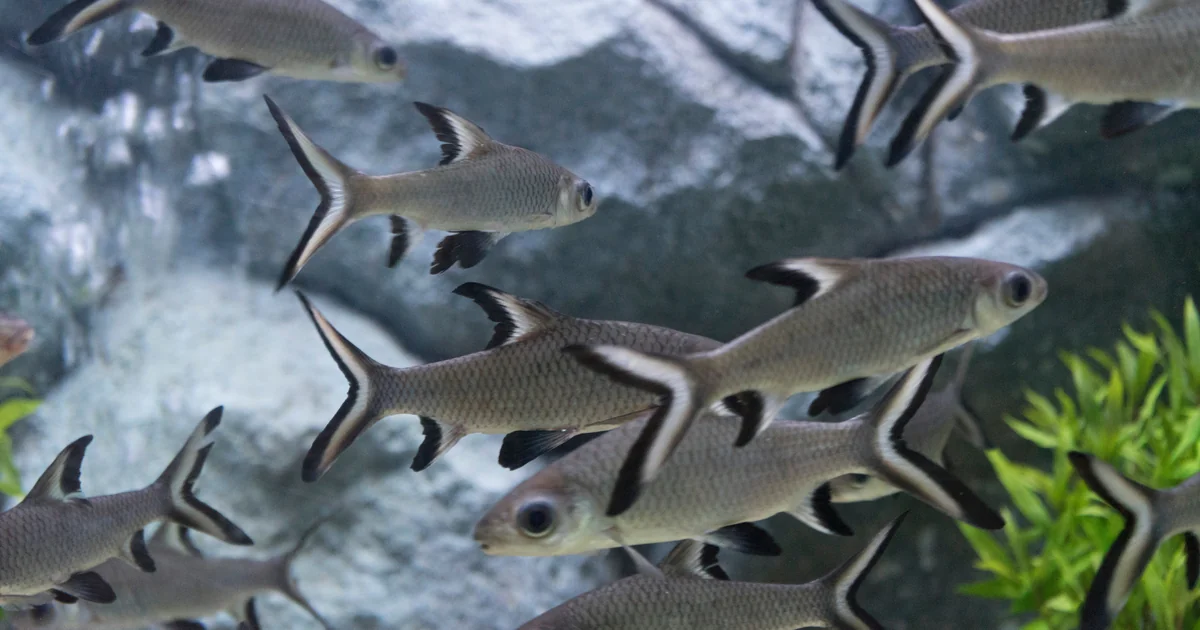
Bala shark care is a topic where the fish-store advice and the actual species requirements have drifted apart over the years. The tank-size guidance you’ve probably seen (“125 gallons” or “150 gallons”) cites the right number but for the wrong dimension. The schooling number (“3-4 fish”) understates what these fish actually need. And almost no care guide mentions that the species is now classified as Vulnerable in the wild, which changes the conversation about where your fish came from. This guide covers what bala shark care actually looks like in 2026, with corrected numbers, sourced parameters, and honest framing.
Bala sharks (Balantiocheilos melanopterus) are large, fast-swimming, schooling cyprinids that grow to 14 inches and live 8 to 15 years in well-maintained tanks. They aren’t true sharks; the shark name comes from their elongated body and high triangular dorsal fin. They’re stunning, peaceful, and surprisingly hardy once their genuine space and group-size needs are met. The catch is that those needs are bigger than most beginners expect.
Disclosure: This post contains affiliate links. If you purchase through a link on this page, we may earn a small commission at no extra cost to you. We only recommend products we’d use in our own tanks.
Bala shark care at a glance
| Attribute | Detail |
|---|---|
| Common Names | Bala shark, Tricolor shark, Silver shark, Tricolor sharkminnow |
| Scientific Name | Balantiocheilos melanopterus |
| Family | Cyprinidae (carps and minnows) |
| Origin | Malay Peninsula, Sumatra, Borneo. Conservation status: Vulnerable (2019 reassessment). Nearly all aquarium specimens are commercial captive-bred. |
| Adult Size | 14 inches (35 cm) is the realistic adult size. Hobby sources sometimes cite 16 in, but those typically include caudal fin or refer to extreme outliers. |
| Lifespan | 8-10 years typical; 12-15 years with excellent care |
| Tank Size | 5 ft (150 cm) tank length minimum for a school of 5 adults. The common “150 gallon” recommendation is a misread of the 150-cm length spec; a 5-ft tank typically holds 125-150 US gallons. |
| Temperature | 72-82°F (22-28°C); ideal 75-79°F |
| pH | 6.0-8.0 (broadly tolerant; one of the most pH-flexible large cyprinids) |
| Temperament | Peaceful, but skittish. Active sustained swimmer. Will eat fish small enough to fit in mouth. |
| Diet | Omnivore leaning insectivore/zooplanktivore. NOT primarily a plant eater. |
| Care Level | Moderate. Hardy individually; the tank size and group-size requirements are the real challenge. |
What bala sharks look like (and how to sex them)
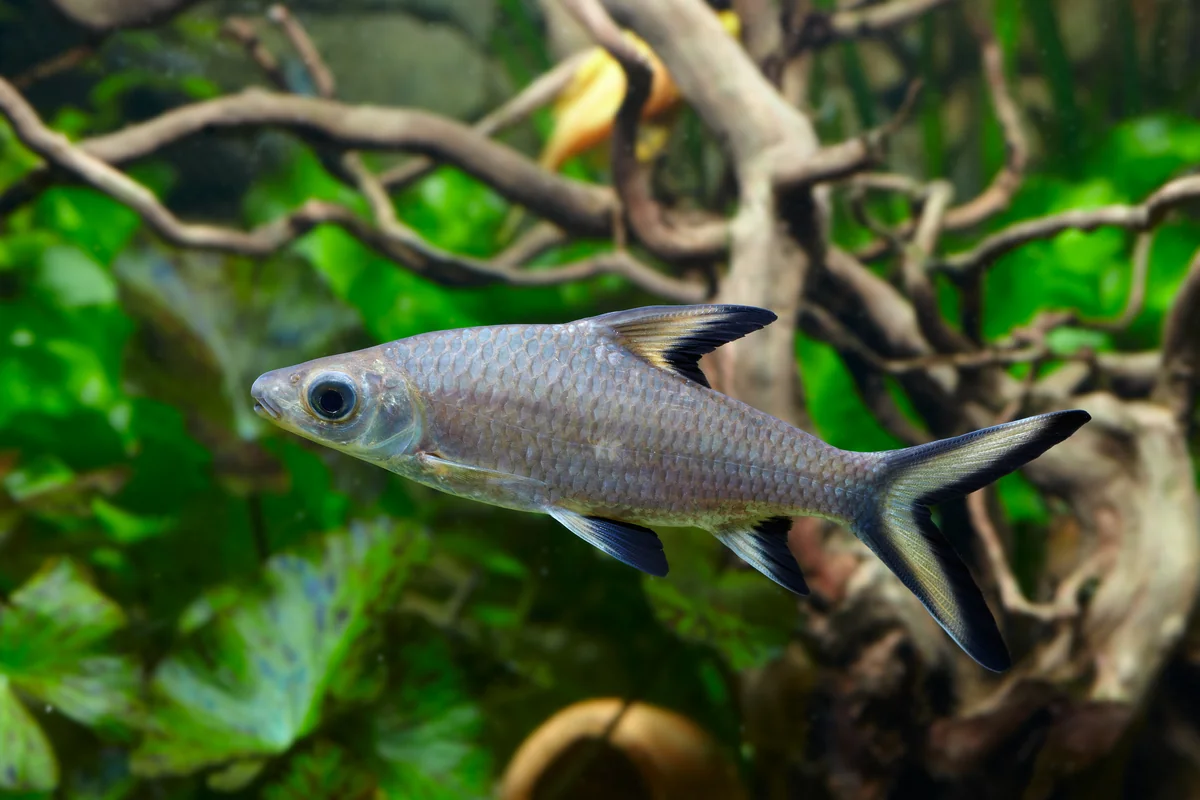
Bala sharks are unmistakable: a streamlined silver body with a high triangular dorsal fin and dark margins on the dorsal, anal, and caudal fins. Juveniles look identical to adults but are dramatically smaller (1-2 inches at sale size). The black-edged tricolor pattern on the fins is the source of the trade name “tricolor shark.” Adult fish are mirror-bright when healthy, with reflective scales that flash in moving water.
Sexing bala sharks is essentially impossible until full adult size. Mature females are slightly deeper-bodied through the abdomen; mature males slightly more streamlined. Captive home-aquarium spawning is unknown; all commercial breeding requires hormone injection at specialized facilities in Southeast Asia, so juveniles you see in stores were almost certainly farmed rather than wild-caught.
Bala shark conservation status: why it matters for buyers
The Red List, the global authority on species extinction risk maintained by the International Union for Conservation of Nature, classifies Balantiocheilos melanopterus as Vulnerable (2019 reassessment). That’s an upgrade from older Endangered listings that some hobby sites still cite. The species has been extirpated from the Batang Hari basin in Sumatra entirely. A sister species, Balantiocheilos ambusticauda, is likely extinct in the wild and hasn’t been recorded in over 30 years.
For aquarists this means two things. First, nearly every bala shark in the trade is captive-bred via hormone-induced spawning at Southeast Asian commercial breeding facilities, so buying one doesn’t directly impact wild populations. Second, the species is genuinely declining in the wild, which makes the responsibility to provide appropriate husbandry to captive specimens more meaningful, not less.
Bala shark tank size and setup requirements
Tank size: length is the constraint, not gallons
The single biggest care guide error for bala sharks is treating “150 gallon tank” as the relevant minimum. The real spec is 150 cm of tank length, roughly 5 feet. A 5-foot tank typically holds 125 to 150 US gallons depending on width and depth, so the right interpretation is “5+ feet long” rather than a specific volume. A tall narrow 150-gallon tank is functionally inadequate; bala sharks are sustained horizontal swimmers and need swim length, not water column height.
| Group size | Tank requirement | Notes |
|---|---|---|
| 5 adults (minimum) | 5 ft (150 cm) length, 125-150 US gal | Practical floor. Less is animal welfare problem. |
| 6+ adults | 6 ft length, 200+ US gal | Recommended for healthy school dynamics. |
Use the aquarium volume calculator to confirm gallons from your tank’s actual dimensions; pet-store gallon labels are sometimes optimistic, and what matters is length plus volume together.
Schooling: 5 minimum, not 3
Bala sharks need groups of 5 or more, not the 3 or 4 commonly cited online. Groups of 2 or 3 produce the worst social outcomes: a hierarchy forms aggressively, the dominant fish bullies the subordinates, and stress chronically suppresses immune function across the group. A solitary bala shark becomes skittish, refuses food, hides constantly, and rarely lives more than a few years.
If you can only fit 3-4, you don’t have the right tank for bala sharks. Choose a different species rather than housing them at the wrong group size.
Filtration
Bala sharks are large, active, and produce significant bioload. Target 6-8× tank volume per hour turnover with multi-stage biological + mechanical filtration. A canister filter (or two on larger tanks) is the practical choice; the volume of media needed for a 150-gallon tank is hard to fit in a hang-on-back form factor. See our best canister filters guide for tank-size matched recommendations.
Bala sharks tolerate moderate flow well (they’re cyprinids from rivers), so high-output canister returns aren’t a problem like they would be for tall-bodied angelfish or discus.
Heating and water conditions
| Parameter | Target |
|---|---|
| Temperature | 72-82°F (22-28°C); ideal 75-79°F |
| pH | 6.0-8.0 (very flexible) |
| GH | 5-12 dGH |
| KH | 3-10 dKH |
| Ammonia / Nitrite | 0 ppm always |
| Nitrate | <30 ppm |
Bala sharks are unusually pH-tolerant. Some experienced keepers maintain them at pH 8.4 with elevated hardness without issues. Stability matters more than the absolute number.
Substrate and decor
Bala sharks are mid-water swimmers, so substrate is mostly cosmetic. Use sand or fine gravel. Decor should be minimal in the open swimming area; they need long unobstructed lanes for sustained swimming. Tall background plants, driftwood along the back wall, and rockwork in the corners create cover without breaking up the central swim path. Avoid filling the tank with hardscape.
What do bala sharks eat?
Bala sharks are commonly described as omnivores, which is true but misleads many keepers into vegetable-heavy diets they will eat but don’t thrive on. Wild bala sharks are predominantly zooplanktivorous and insectivorous: small crustaceans (copepods, ostracods, cladocerans), rotifers, insect larvae, and occasional phytoplankton. Plant material is opportunistic, not preferential.
In captivity, build the diet around a high-quality protein-based pellet or flake (40-45% protein), supplemented with frozen and live foods.
| Food | Type | Notes |
|---|---|---|
| High-protein flake or sinking pellet | Daily staple | Tropical Color Plus, Hikari Sinking Wafers, Northfin Community formula. Sized for 14-inch fish. |
| Frozen bloodworms, brine shrimp, mysis | Protein supplement | 2-3× weekly. Highly attractive; supports color and growth. |
| Live blackworms or small crickets | Premium live food | Occasional treat. Source from reliable cultured suppliers, not wild-collected. |
| Spirulina flakes or blanched zucchini | Plant supplement | Once weekly. Provides fiber. Keep portions modest; bala sharks prioritize protein. |
Adults thrive on two daily feedings sized so all food is consumed within 3-4 minutes. Juveniles eat aggressively and grow rapidly; feed them three smaller meals during their fastest growth year.
For sinking pellet recommendations sized for adult bala sharks, Hikari Tropical Sinking Wafers are the standard pick: they sink fast into the swim zone, hold together long enough for slow-eating fish at the bottom of a fast-flow tank, and the size suits 14-inch fish:
![Hikari Tropical Sinking Wafers for Catfish, Loaches and Bottom Feeders 3.88 Ounces [2-Pack]](https://m.media-amazon.com/images/I/71wojil3+nL._AC_SX466_.jpg)
Best bala shark tank mates (and what to avoid)
| Species | Compatibility | Notes |
|---|---|---|
| Other Bala Sharks | Good | 5+ minimum. Large groups are ideal. |
| Silver Dollars | Good | Similar size, peaceful schooler. Classic 5-foot tank pairing. |
| Clown Loaches | Good | Bottom-dweller, similar size, similar parameters. Excellent companion. |
| Plecos (large species) | Good | Common pleco, sailfin pleco. Algae cleanup, peaceful, size-matched. |
| Larger Tetras (Congo, rummynose) | Good | Active mid-water schoolers. Too big to eat. Match the activity level. |
| Discus / Angelfish | Caution | Different temperament. Bala sharks’ speed and feeding behavior outcompete slow methodical eaters. Possible in 200+ gal. |
| Goldfish | Avoid | Cool-water fish; temperature mismatch. |
| Small fish (neon tetras, ember tetras) | Avoid | Will be eaten by adult bala sharks. Anything under 1.5 inches is at risk. |
| Aggressive cichlids (oscars, jaguar cichlids) | Avoid | Will harass skittish bala sharks; territorial conflict. |
| Dwarf shrimp / snails | Avoid | Bala sharks will eat them. Mystery snails large enough may survive but are at risk. |
Common bala shark diseases and how to treat them
Healthy bala sharks swim actively in the open water column with mirrored silver bodies and crisp dark fin margins. Faded color, listless behavior, hiding behind decor, or rapid gill movement signal stress or illness.
| Condition | Symptoms | Treatment |
|---|---|---|
| Ich | White grain-of-salt spots on fins and body | Raise temp to 84°F + salt 0.1-0.2%, or Ich-X for 7-10 days |
| Stress-induced ammonia burn | Red gill flares, gasping, sluggish behavior | Test ammonia immediately; large water change, dose Prime, address filtration capacity |
| Fin damage from jumping | Torn or ragged fin edges, often after a jump | Clean water + time. Antibiotics only if secondary bacterial infection appears. |
| Internal parasites | Wasting despite eating; stringy white feces | Praziquantel + metronidazole (PraziPro). Quarantine new arrivals. |
Most bala shark health issues trace back to undersized tanks, improper group size, or jumping injuries. Get those three right and they’re a remarkably hardy species.
Bala shark care FAQs
How big do bala sharks get?
Adult bala sharks reach 14 inches (35 cm). Some hobby sources cite 16 inches, but those typically include the caudal fin or refer to extreme outliers. Plan for 14 inches as the realistic adult size.
How many bala sharks should I keep?
Five minimum, six or more ideal. Groups of 2-3 produce aggressive hierarchy dynamics that bully subordinate fish. Solitary maintenance produces chronically skittish, food-refusing fish.
What size tank do bala sharks need?
A 5-foot (150 cm) tank length minimum, which typically holds 125-150 US gallons. Length matters more than gallons because bala sharks are sustained horizontal swimmers. A tall narrow 150-gallon tank is functionally inadequate.
Are bala sharks endangered?
The Red List classifies the species as Vulnerable (2019 reassessment), an upgrade from older Endangered listings still cited on some hobby sites. Wild populations are declining, but nearly every aquarium specimen is captive-bred via hormone-induced spawning at SE Asian commercial farms.
How long do bala sharks live?
8-10 years typical in well-maintained captivity. Excellent care extends lifespan to 12-15 years. The most common lifespan-cutter is undersized tank or wrong group size, which produces chronic stress.
Is a bala shark right for your tank?
Bala shark care is uncomplicated once you accept the fixed costs: a 5-foot tank, a school of 5 or more, sustained horizontal swim space, and a tight lid. Get those right and the day-to-day is straightforward. They tolerate a wide pH range, eat readily, and don’t have the niche disease vulnerabilities of more demanding species. The trap is buying juveniles at 1-2 inches in pet stores and underestimating what a 14-inch fish needs three years later.
For matched filtration recommendations on tanks this size, see our best canister filters and best aquarium filters guides. The 5-foot tank itself is the bigger commitment; bala sharks reward keepers who plan the tank around the fish, not the other way around.