Most beginner guides for white cloud mountain minnow care undersell what this fish actually is. They treat it like a starter goldfish alternative or a “hardy budget option” for new aquarists. That framing misses the point. White Cloud Mountain Minnows are vibrantly colored schooling fish from cool mountain streams in southern China, and they thrive without a heater in temperatures that would kill most tropical community fish.
If you live in a cool home, want a heater-free nano tank, or have a shaded patio where a small outdoor tub could sit for the summer, this is one of the most rewarding species in the freshwater hobby. They are also a quiet conservation success story. Every White Cloud sold today is captive-bred, and the trade has effectively kept the species alive while wild populations in the White Cloud Mountains near Guangzhou have nearly disappeared.
Disclosure: This post contains affiliate links. If you purchase through a link on this page, we may earn a small commission at no extra cost to you. We only recommend products we’d use in our own tanks.
White Cloud Mountain Minnow care at a glance
| Attribute | Detail |
|---|---|
| Common names | White Cloud Mountain Minnow, White Cloud, Poor Man’s Neon |
| Scientific name | Tanichthys albonubes |
| Family | Cyprinidae (carps and minnows) |
| Origin | China, White Cloud Mountains, near Guangzhou |
| Adult size | 1.5 in (4 cm) |
| Lifespan | 5–7 years |
| Tank size minimum | 10 gallons for a school of 6–8 |
| Temperature | 60–72 °F (coolwater) |
| pH | 6.0–8.0 (broad tolerance, GH 5–20 dGH) |
| Temperament | Peaceful, active schooler |
| Diet | Omnivore, flake, micro-pellets, frozen and live foods |
| Care level | Easy |
What white cloud mountain minnows look like (and how to sex them)
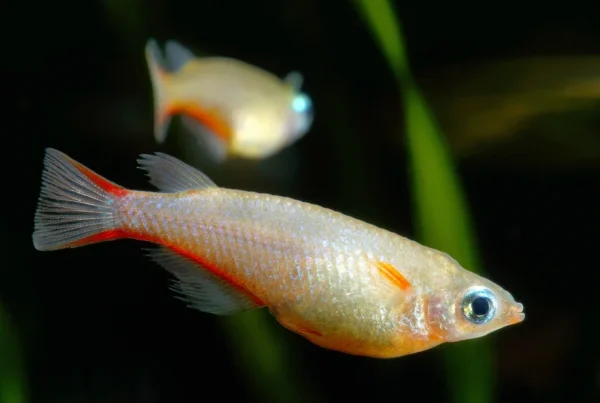
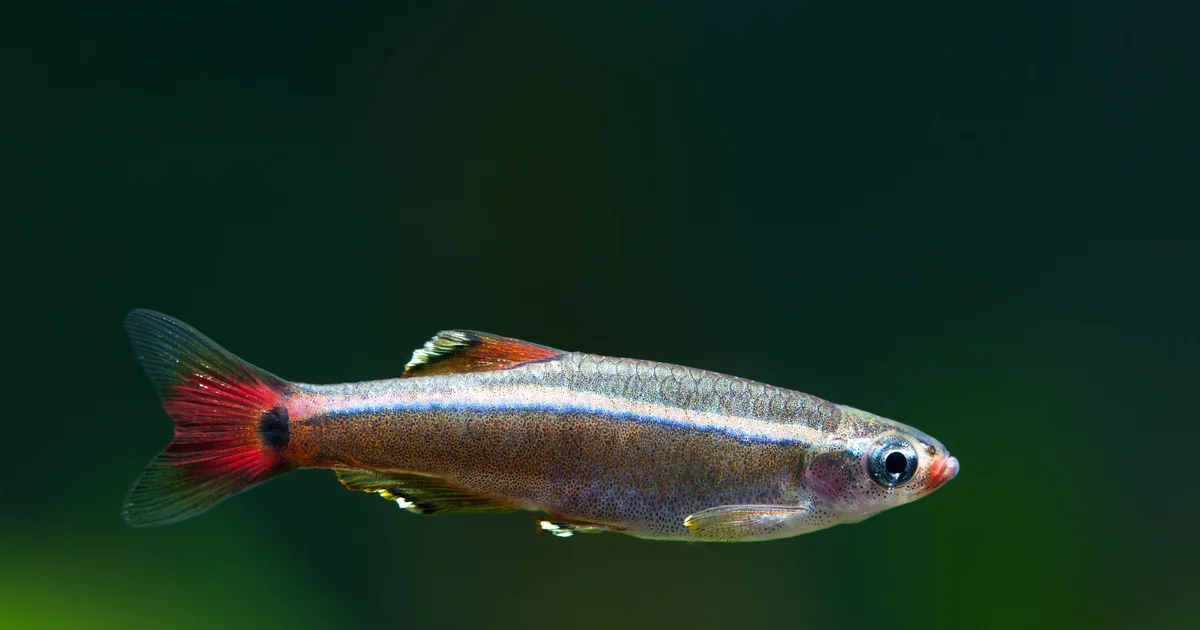
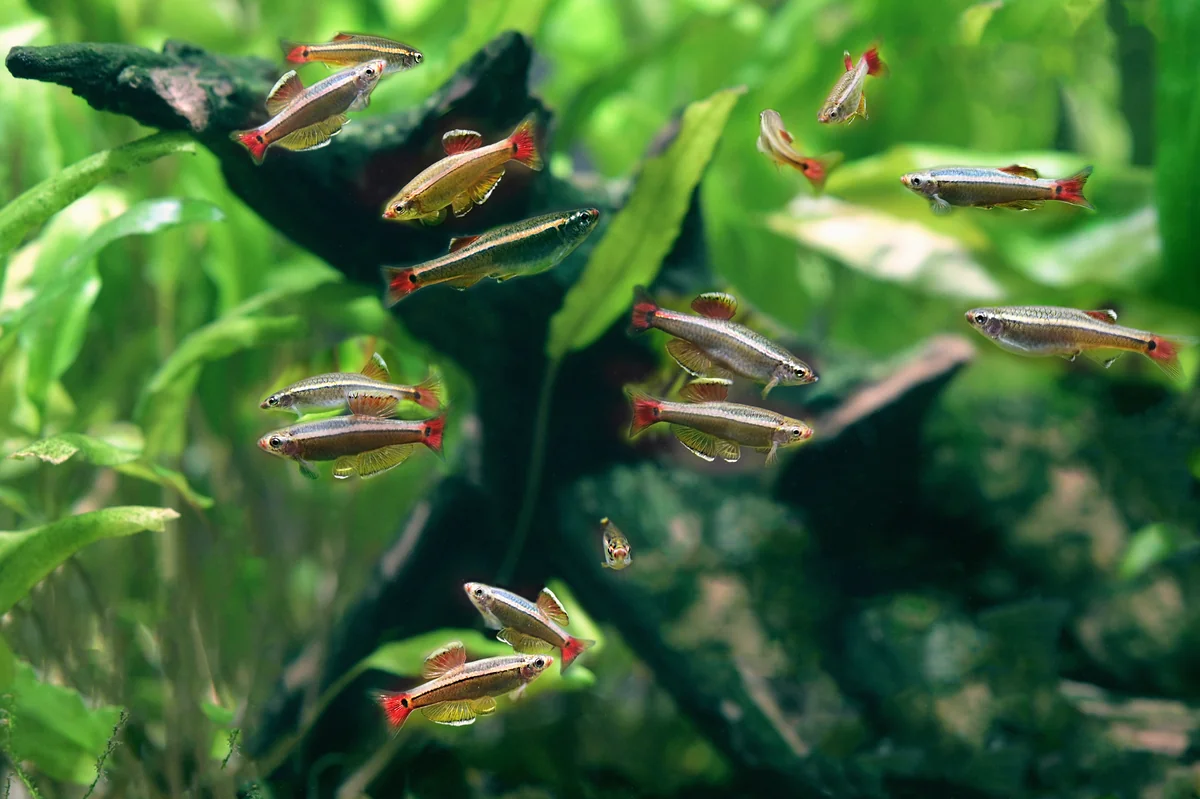
A healthy adult White Cloud is about 1.5 inches long, with a slim torpedo-shaped body, a luminous green-blue or teal lateral stripe running from gill to caudal peduncle, and red coloration on the dorsal, anal, and caudal fins. Under direct light the stripe shimmers like a sliver of mother-of-pearl, which is where the “Poor Man’s Neon” nickname comes from. The fish is built for speed and constant motion across the middle of the water column.
Wild-type and captive-bred stock look similar, but decades of selective breeding have intensified the red fin coloration and brightened the lateral stripe in commercial stock. The brightest commercial fish actually exceed wild-type intensity, a side effect of breeders selecting for showier color over generations.
Sexing White Clouds is straightforward once they reach adult size. Males are noticeably slimmer, with deeper red on the fin edges and more elongated dorsal and anal fins, especially in mature display posture. Females are rounder in the belly, particularly when conditioned on rich foods, and their fin coloration is more muted. In a healthy school of 8 or more, you’ll usually end up with a workable mix of both sexes, which means breeding can happen without you specifically pairing fish.
White cloud mountain minnow color varieties and line-bred forms
Three main forms are sold in the hobby. All three share identical care requirements, so the choice is purely cosmetic.
| Variety | Appearance | Notes |
|---|---|---|
| Standard (wild-type) | Silver-gray body, green-blue lateral stripe, red fins | Most widely available, hardiest stock; the baseline for comparison |
| Long-fin (Meteor Minnow) | Same body coloration; elongated dorsal and caudal fins that flow behind the fish | Slightly more delicate; long fins can fray from rough decor or strong flow |
| Gold form | Pale yellow-gold body with faint stripe, lighter red fins | Line-bred variant; the muted body lets the red fins pop more visibly |
| “Vietnamese” / Sundanese form | More vivid red and yellow tones across the body, debated taxonomy | Occasionally sold as a separate population; treat husbandry identically |
White cloud mountain minnow temperature: the coolwater advantage
This is the single most important fact about the species, and the one most articles bury or skip entirely. White Cloud Mountain Minnow temperature preferences are 60–72 °F. They are not tropical fish. They come from cool mountain streams, and they actively prefer water that most heated community tanks would consider too cold.
In practice, this means you can run a White Cloud tank in an unheated room in most temperate-climate homes. If your indoor air sits between 65 and 72 °F year-round, the water will follow, and the fish will be in their happy zone without you running a heater at all.
This coolwater preference is also why White Clouds pair so well with other cool-tolerant species. Panda corys, hillstream loaches, and dojo loaches all share the same preference for water below 75 °F. Together they form one of the few genuine unheated community options in the freshwater hobby. By contrast, classic tropical schoolers like cardinal tetras or German blue rams need 78 °F or higher and should never share a tank with White Clouds, the temperature mismatch is fatal to one side or the other.
White cloud mountain minnow tank size and setup
The minimum white cloud mountain minnow tank size is 10 gallons for a school of 6 to 8 fish. A 20-gallon long is the sweet spot, the extra horizontal swimming room lets the school spread out and display the active mid-water behavior they’re known for. White Clouds are surprisingly fast swimmers for their size, and a cramped footprint reduces them to hiding in corners.
For a true nano build under 10 gallons, see our guide to fish for 5-gallon tanks. Five gallons is too small for a proper White Cloud school, and we don’t recommend pushing it.
Filtration and flow
Gentle filtration suits them. A sponge filter or a low-flow hang-on-back unit covers a 10–20 gallon White Cloud tank without trouble. They don’t need the heavy current that hillstream loaches require, but they also don’t object to moderate flow. Avoid filters that create a vortex or strong directional current across the entire footprint, since the fish will spend their time fighting it instead of schooling.
Water parameters
White Clouds have one of the broadest pH and hardness tolerances in the hobby. The species comfortably handles a pH range of 6.0 to 8.0 and a GH between 5 and 20 dGH. For most municipal tap water, this means you can use what comes out of the tap (after dechlorination) without adjustment. A reliable liquid test kit confirms your starting parameters and lets you track ammonia and nitrite during the cycling phase. I use the API Freshwater Master Test Kit for this — it covers the four readings that matter on a new tank (pH, ammonia, nitrite, nitrate) out of a single box, and the reagents last long enough that a single kit lasts most casual keepers a year or two.
Substrate, plants, and aquascape
Fine gravel or sand both work. The fish don’t dig, and they don’t have specialized substrate needs. Live plants suit them well, especially cool-tolerant species like Java moss, Java fern, hornwort, and Anubias. These plants do not require high lighting or heated water, which matches the unheated-tank theme perfectly. Provide some open swimming space across the middle and upper portion of the tank, that’s where the school will actually live.
How many white clouds should you keep? The 8+ school rule
The legacy hobby advice of “6 minimum” is the bare floor, not the target. Modern welfare consensus across schooling species has shifted upward, and White Clouds benefit from the same correction. A group of 6 will technically survive, but they tend to school loosely, hide more, and show muted color compared to a larger group.
For confident behavior and proper color expression, aim for 8 to 10 or more. In a 20-gallon long, a school of 12–15 looks spectacular and gives the fish enough peers to display the natural tight-schooling behavior that makes the species worth keeping. Furthermore, larger groups also reduce stress on individual fish, which translates to better feeding response and healthier overall condition.
White cloud mountain minnow tank mates (and what to avoid)
Tank mate selection comes down to one rule: stay in the coolwater zone. White Clouds are peaceful and won’t bother smaller species, but the temperature ceiling is what limits the compatibility list. Any fish that needs 78 °F or higher is a mismatch.
Good companions share both the cool temperature preference and a similarly peaceful temperament. Panda corys (which prefer cooler water than most other corys), hillstream loaches, and dojo loaches all work beautifully in a true coolwater community. Adult cherry shrimp are also safe, the White Cloud’s small mouth and peaceful disposition mean adult shrimp are ignored, though very small shrimplets may be eaten.
I’m planning to add a White Cloud school to my own hillstream loach tank for exactly this reason. The temperature preferences line up almost perfectly (hillstreams want roughly 68–75 °F, White Clouds want 60–72 °F, so the overlap zone of 68–72 °F suits both species comfortably), and the two occupy different parts of the tank, hillstreams on the rocks and glass, White Clouds in the open middle column. It’s one of the few combinations where a true unheated coolwater community can carry visible action across the bottom AND the mid-water at the same time.
| Species | Compatibility | Notes |
|---|---|---|
| Panda Cory | Good | Shared cool temperature preference (68–77 °F); peaceful bottom-dweller |
| Hillstream Loach | Good | Coolwater algae grazer (65–75 °F); needs more flow, but the species coexist |
| Dojo Loach | Good | Cold-tolerant (40–75 °F); needs a 40+ gallon tank due to adult size |
| Cherry Shrimp (adult) | Good | Adult shrimp safe; shrimplets may be eaten in open tanks |
| Endler’s Livebearer | Caution | Temperature edge: Endlers prefer 72–78 °F; works in cool homes that stay around 72 °F, risky if room runs warmer |
| Otocinclus | Caution | Otos prefer 72–79 °F; the overlap zone is narrow (72 °F), and otos struggle below it |
| Cardinal Tetra | Avoid | Needs tropical temps (78 °F+); fatal mismatch |
| German Blue Ram | Avoid | High-temperature cichlid (82 °F+); cannot coexist |
| Goldfish | Avoid | Despite temperature overlap, adult goldfish will eat White Clouds |
The goldfish question comes up often because of the temperature overlap. The answer is no. Adult goldfish are large, opportunistic predators relative to a 1.5-inch minnow. For the broader picture on what works (and doesn’t) with goldfish, see our guide to goldfish tank mates.
White cloud mountain minnow outdoor pond and tub culture
This is where White Clouds really stand out. The species works in outdoor garden ponds and patio tubs in mild climates, and is frost-tolerant for short periods. For keepers in USDA zones 6–9, a seasonal outdoor tub is one of the most rewarding ways to keep them.
A food-grade plastic tub or stock tank of 40 gallons or larger, sited in partial shade, with hardy plants like hornwort and water lettuce, makes an excellent summer home. The fish will color up beautifully under natural light, breed readily, and help control mosquito larvae as a bonus. For a closer look at the infrastructure principles, our outdoor pond stocking guide covers similar considerations for small-fish tub culture.
Seasonal management
In summer, feed normally and watch for excessive heat, a tub in full sun can exceed 80 °F, which stresses the fish. Partial shade and depth (12 inches or more) help buffer temperature swings. As autumn approaches, reduce feeding as the water cools. In colder zones (5 and below), or anywhere a hard freeze will reach the bottom of the tub, bring the fish indoors before winter. In zones 6–8 with deeper tubs, White Clouds can overwinter outdoors, though sustained sub-freezing weather is a risk.
White cloud mountain minnow diet and feeding
White Clouds are easy omnivores. They eat almost anything small enough to fit in their mouths and will surface-feed enthusiastically. A staple of high-quality micro-pellet or crushed flake covers their nutritional base. Variety improves their color and breeding readiness, so rotating in frozen daphnia, mosquito larvae, or small bloodworms a few times a week is worth the effort.
In outdoor tubs they’ll actively hunt live mosquito larvae, which is both excellent nutrition and a practical pest-control benefit. Indoors, live or frozen brine shrimp and daphnia are the closest equivalents.
| Food | Type | Notes |
|---|---|---|
| High-quality micro-pellet or crushed flake | Staple | Daily; small portions to avoid waste |
| Frozen daphnia | Supplementary | 2–3x weekly; enhances color and conditioning |
| Frozen or live bloodworms | Supplementary | 1–2x weekly; rich in protein, supports breeding |
| Live mosquito larvae | Natural / outdoor | Available freely in outdoor tubs; excellent conditioning food |
Feed once or twice daily, only what the school will consume in about a minute. Overfeeding is the most common cause of water-quality issues in small unheated tanks, and White Clouds don’t need much food to thrive.
Breeding white cloud mountain minnows in unheated tanks
Breeding White Cloud Mountain Minnows is one of the easiest spawning projects in the hobby, and it requires no heater. A healthy, well-fed school in the 64–72 °F range will spawn readily without intervention. The fish are egg-scatterers; males chase females through plant cover, and eggs settle into mosses or fine-leaved vegetation.
For higher fry survival, provide dense Java moss or commercial spawning mops. Adults will eat eggs and fry if given the chance, so a heavily planted tank or a dedicated breeding setup with the eggs removed to a separate container produces the best results. Fry are very small and need infusoria or commercial liquid fry food for the first week, then microworms, and finally newly hatched brine shrimp as they grow.
Cycling and water quality for new white cloud tanks
White Clouds are hardy enough to tolerate fish-in cycling if you’ve already brought them home before learning about the nitrogen cycle. That said, a fishless cycle is still the welfare standard, it lets you establish beneficial bacteria without exposing the fish to ammonia and nitrite spikes at all.
If a fish-in approach is unavoidable, stock lightly (no more than 3–4 fish in a 10-gallon to start), test water daily, perform 25–50% water changes whenever ammonia or nitrite reads above 1 ppm, and use a dechlorinator with ammonia-detoxifying properties like Seachem Prime. The API Freshwater Master Test Kit is the standard for this, it tests ammonia, nitrite, nitrate, and pH from a single bottle of reagents.
Why every White Cloud you buy is a conservation story
Here’s the part most care guides leave out: Tanichthys albonubes is listed by the IUCN as Critically Endangered in its native range. The original mountain streams near Guangzhou have been nearly extirpated due to habitat loss and urbanization. In other words, the wild population has effectively collapsed.
The hobby trade, however, has the species in massive captive-bred production. Effectively every White Cloud sold in the global aquarium hobby today is farm-raised, often in commercial breeding operations in Southeast Asia and Eastern Europe. The species exists today largely because hobbyists kept demanding it and breeders kept producing it. It’s a quiet conservation success, the kind that doesn’t make headlines but matters.
This means you don’t have to worry about wild-collection ethics when buying White Clouds. Standard hobby stock is captive-bred by default. The line-bred varieties, long-fin and gold-colored forms, are particularly clear evidence of the captive lineage, since these traits don’t exist in the wild.
Common white cloud diseases and how to treat them
White Clouds are one of the hardiest species in the hobby, so disease is usually a sign of a husbandry problem (chronic chill, ammonia, poor diet, or a too-small school) rather than something the fish “just caught.” A healthy White Cloud is active in the middle water column, has vivid red fins and a visible green-blue lateral stripe, eats eagerly at feeding time, and shows no clamped fins, no flashing, and no whitish patches. If your fish drift away from that baseline, look at water quality and school size FIRST before reaching for medications.
That said, four conditions account for almost every case of illness reported in the species:
| Condition | Symptoms | Treatment |
|---|---|---|
| Ich (white spot) | Small white salt-like spots on body and fins, flashing against decor, clamped fins | Treat with a freshwater-safe ich medication (Ich-X, Kordon Rid-Ich, etc.). Avoid the classic “raise temp to 86 °F” protocol since White Clouds are stressed above 75 °F; rely on medication and aquarium salt instead |
| Fin rot | Frayed, discolored, or receding fin edges; often starts at the tail tips | Identify and fix the underlying water-quality issue (test ammonia, nitrite, nitrate), perform a large water change, and treat with API Furan-2 or Maracyn 2 if the rot is progressing |
| Columnaris | White cottony or fuzzy patches around the mouth, gills, or back; rapid breathing; fish becoming lethargic quickly | Aggressive antibiotic treatment with Kanaplex or Maracyn 2. Columnaris progresses fast in warm water, so quarantine affected fish to a separate tank kept at the cooler end of the range (62–66 °F) |
| Swim bladder issues | Listing to one side, floating upside down, sinking to the bottom and struggling to swim up | Fast the fish for 24–48 hours, then offer a single de-shelled cooked pea as a laxative; check water temperature and food quality (low-quality flake that expands rapidly is a common trigger) |
Prevention beats treatment in every case. Quarantine new fish in a separate tank for 2–4 weeks before adding them to the main tank, keep the school at 8 or more so individuals don’t suffer chronic stress, hold temperatures in the 60–72 °F band consistently, and stay disciplined on water changes (25% weekly is plenty for a lightly stocked White Cloud tank). Healthy White Clouds frequently live 5–7 years with this kind of routine.
White Cloud Mountain Minnow care FAQs
Do White Cloud Mountain Minnows need a heater?
No. Their preferred temperature range is 60–72 °F, which is below the typical setting of a tropical heater. If your home stays between 65 and 72 °F year-round, the tank water will follow, and the fish will be at ideal temperature without one. Only consider supplemental heating if your home regularly drops below 55 °F in winter.
How many White Clouds can I keep in a 10-gallon tank?
A school of 6 to 8 is the practical maximum for a 10-gallon. If you want to push toward the 8–10+ welfare ideal, a 15- or 20-gallon long is a better long-term choice.
Can White Clouds live with goldfish?
No. Despite the temperature overlap, adult goldfish will eat 1.5-inch minnows. The size disparity is too great for safe coexistence.
Can White Clouds live outside year-round?
In mild climates (USDA zones 7–9) with adequate tub depth and protection from hard freezes, yes. In zones 5–6, summer-only outdoor culture with indoor wintering is the safer approach. In zones 4 and below, the tub will freeze through and the fish must come inside.
Why are my White Clouds pale or hiding?
The most common cause is too small a school. Groups under 6, and even groups of 6–7 in some cases, produce stressed, drab fish. Increase the group to 8 or more and color and confidence usually return within a week. Other possibilities include water that’s too warm (above 75 °F for extended periods) or poor water quality during a still-cycling tank.
Is a White Cloud Mountain Minnow right for your tank?
If you want an active, colorful, easy schooling fish that doesn’t need a heater, tolerates a wide range of water parameters, and can move outdoors for the summer, the answer is yes. White Clouds reward keepers who give them enough schoolmates (8 or more), enough swimming room (a 20-gallon long if possible), and the cool water they actually prefer.
They also pair naturally with other coolwater species like panda corys and hillstream loaches, opening up a community-tank possibility that most tropical-focused care guides never mention. And every fish you buy supports a captive-breeding system that has effectively rescued the species from extinction.
For a broader starting point, our first aquarium setup guide walks through the cycling and equipment basics that apply to any beginner tank. From there, the only question is how cool your room stays, and whether you want to skip the heater entirely.