If you’ve ever locked eyes with a juvenile oscar at the pet store and thought “I need that fish,” welcome to the crash course in oscar fish care that I wish someone had handed me years ago. That cute little 2-inch fish in the display tank? It’s going to be a foot long within a year, rearrange every decoration you own, and beg you for food like a Labrador. And you’ll love every minute of it.
Oscars (Astronotus ocellatus) are one of the most personable freshwater fish you can keep. They recognize their owners, can be hand-fed, and some will even play with ping pong balls. But that personality comes with real demands — big tanks, heavy filtration, and a commitment to water quality that a lot of impulse buyers aren’t ready for. This guide covers everything you need to know to keep oscars healthy and thriving, from tank setup to diet to dealing with the dreaded hole-in-the-head disease.
Disclosure: This post contains affiliate links. If you purchase through a link on this page, we may earn a small commission at no extra cost to you. We only recommend products we’d use in our own tanks.
Quick Overview
| Attribute | Detail |
|---|---|
| Common Names | Oscar, Oscar Cichlid, Tiger Oscar, Velvet Cichlid, Marble Cichlid, Water Dog |
| Scientific Name | Astronotus ocellatus |
| Family | Cichlidae |
| Origin | South America — Amazon River basin (Brazil, Peru, Colombia, French Guiana) |
| Adult Size | 12–14 inches (30–35 cm) in captivity; up to 18 inches (45 cm) in the wild |
| Lifespan | 10–15 years with proper care; some exceed 20 years |
| Tank Size | 75 gallons minimum (single oscar); 125+ gallons for pairs or community |
| Temperature | 74–80 °F (23–27 °C) |
| pH | 6.0–8.0 (ideal: 6.5–7.5) |
| Temperament | Semi-aggressive to aggressive; territorial, especially during breeding |
| Diet | Omnivore (protein-heavy); pellets, insects, frozen foods, occasional vegetables |
| Care Level | Moderate — hardy fish, but demands large tank and consistent maintenance |
Appearance
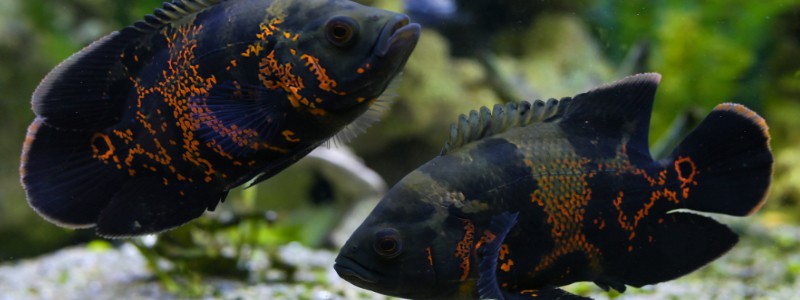
Wild oscars are actually pretty understated — dark olive to charcoal base color with faint orange-ringed spots (ocelli) near the tail, which likely serve as false eyespots to confuse predators. Captive breeding has turned that subtle palette into something far more dramatic. Decades of selective breeding have produced oscars in vivid reds, bright oranges, pale albinos, and just about everything in between.
Body-wise, oscars are thick and oval-shaped with powerful, rounded fins. They’ve got a large mouth and — here’s a fun fact — their real teeth are located in their throat (pharyngeal teeth), not in their visible jaw. That’s why they feed with a distinctive suction-and-gulp motion rather than biting. Juveniles look nothing like adults. They typically have white and orange wavy bands that shift dramatically as they mature, which is half the fun of raising one from a baby.
Sexual Dimorphism
Here’s the honest truth: telling male and female oscars apart is extremely difficult outside of breeding season. There are no reliable external differences in color, fin shape, or size. During spawning, the female’s ovipositor (egg tube) becomes visible and is broader and blunter than the male’s pointed breeding tube. The most reliable method is venting — examining the genital papilla — but even that takes experience. If you’re serious about breeding, your best bet is to raise a group of 4-6 juveniles and let them pair off naturally.
Oscar Types and Varieties
All oscar varieties are the same species (Astronotus ocellatus) and require identical care. The differences are purely cosmetic. Here are the most common morphs you’ll find:
| Variety | Description |
|---|---|
| Tiger Oscar | The most common variety. Dark base (black/dark gray) with irregular orange or red patches and stripes. Closest in pattern to wild-type oscars. This is what most people picture when they hear “oscar fish.” |
| Red Oscar | Selectively bred for maximum red/orange coverage. The dark base is reduced to smaller patches, giving the fish a predominantly red-orange appearance. Very popular in the hobby. |
| Albino Oscar | White to pale pink base with red or orange markings. Red eyes. Available in albino tiger and albino red variants. Slightly more sensitive to bright lighting. |
| Lemon Oscar | Pale yellow to bright lemon coloring replacing the typical orange/red pigments. Less commonly available but striking when you find one. |
| Veil Tail Oscar | Long, flowing fins — a genetic trait that can appear in any color variety. Dramatic-looking but the extended fins can be more prone to fin damage and nipping from tank mates. |
| Black Oscar | Very dark overall coloring with minimal orange or red markings. Sometimes called “walnut oscar” due to the dark, textured appearance. Less flashy but genuinely impressive at full size. |
Tank Setup
This is where a lot of new oscar keepers get it wrong. That baby oscar in the store will grow over an inch per month and reach full size in roughly 12-14 months. Planning for the adult fish from day one saves you money, stress, and a stunted, unhealthy pet.
Tank Size
I recommend a 75-gallon tank as the absolute minimum for a single adult oscar. Can they physically fit in a 55? Sure, but they won’t thrive — it’s like keeping a golden retriever in a studio apartment. A 75 gives them enough swimming room and dilution volume to manage their waste output. If you’re keeping a pair or adding tank mates, you’re looking at 125 gallons minimum, and honestly, a 125 or 150 is where things start getting comfortable.
Go with a tank that’s longer rather than taller. Oscars are horizontal swimmers, and a standard 75-gallon (48″ x 18″ x 21″) gives them much better swimming space than a tall hex tank of the same volume.
Filtration
Oscars are messy. Like, really messy. They’re big fish that eat a lot of protein, and they produce waste proportional to their appetite. Your filter needs to turn over the entire tank volume at least 4-5 times per hour. For a 75-gallon tank, that means a filter rated for at least 300-375 GPH.
A quality canister filter is the gold standard for oscar tanks. They offer excellent mechanical and biological filtration, sit outside the tank (so your oscar can’t destroy them), and handle heavy bioloads well. For tanks 75 gallons and up, I’d look at the Fluval FX4 or FX6 — they’re workhorses built for exactly this kind of setup. If you’re running a really large tank, check out our guide to the best filters for large aquariums.
Heating
Oscars are tropical fish and need stable temperatures between 74-80°F. A reliable, adjustable aquarium heater is a must. For a 75-gallon tank, you’ll want a 200-300 watt heater. For larger tanks, consider running two heaters on opposite ends for even heat distribution.
Here’s something people overlook: oscars don’t tolerate temperature swings well. A cheap heater that fluctuates 3-4 degrees throughout the day will stress your fish out over time. Invest in a quality heater with accurate thermostat control.
Water Conditions
| Parameter | Target Range |
|---|---|
| Temperature | 74–80 °F (23–27 °C) |
| pH | 6.0–8.0 (ideal: 6.5–7.5) |
| General Hardness (GH) | 5–20 dGH |
| Ammonia | 0 ppm |
| Nitrite | 0 ppm |
| Nitrate | Below 20 ppm (lower is better) |
Weekly water changes of 25-30% are non-negotiable. With the amount of waste oscars produce, skipping water changes is the fastest path to health problems — especially hole-in-the-head disease. I do 30% every Sunday on my oscar tank like clockwork. Always treat new water with a dechlorinator before adding it.
Substrate and Decorations
Keep it simple. Oscars will rearrange, uproot, and destroy most decorations. Fine sand or smooth gravel works well for substrate — it’s easy to clean and won’t injure them as they sift through it. Some keepers go bare-bottom for easy maintenance, which honestly isn’t a bad call for a dedicated oscar tank.
Live plants are generally a waste of money in an oscar tank. These fish will uproot anything not bolted down. If you want greenery, tough plants like java fern or anubias attached to heavy driftwood or rocks have the best chance of surviving, but even that’s not guaranteed. Large rocks, driftwood, and PVC structures (if you don’t care about aesthetics) make good decor — just make sure everything is heavy or secured enough that your oscar can’t topple it against the glass.
Diet and Feeding
Oscars are omnivores that lean heavily toward protein. In the wild, they eat insects, crustaceans, small fish, worms, and even fruits and nuts that fall into the water. In captivity, a high-quality cichlid pellet should be the foundation of their diet, supplemented with a rotation of frozen and live foods to keep them healthy and interested.
Recommended Foods
| Food | Type | Notes |
|---|---|---|
| Hikari Cichlid Gold | Pellet (staple) | Excellent all-around pellet. High protein, color-enhancing. Should make up 60-70% of diet. |
| Frozen Shrimp (shell-on) | Frozen | Great protein source. Raw, uncooked, unseasoned grocery store shrimp works fine. The shell provides roughage. |
| Frozen Bloodworms | Frozen | Oscars go crazy for these. Feed as a treat 1-2 times per week, not as a staple. |
| Crickets / Grasshoppers | Live | Mimics natural diet. Buy from pet/reptile suppliers — never use wild-caught insects (pesticide risk). |
| Earthworms | Live | Excellent, nutritious live food. Farm-raised or dig your own from untreated soil. |
| Blanched Peas | Vegetable | Remove the skin first. Helps digestion and adds variety. Feed once a week. |
Feeding Schedule
Adult oscars should be fed once or twice daily. Give them only as much as they can consume in about 2-3 minutes. Oscars are beggars — they’ll act starving 24/7 — but overfeeding leads to excess waste, poor water quality, and health issues. Juveniles (under 6 inches) can be fed 2-3 times daily in smaller amounts to support their rapid growth.
One fasting day per week is actually beneficial for adult oscars. It gives their digestive system a break and helps prevent bloating.
Tank Mates
Let me be upfront: most experienced oscar keepers end up housing their oscars alone or with one or two carefully chosen companions. Oscars are territorial, they eat anything that fits in their mouth, and they can be unpredictable even with fish they’ve coexisted with for months. That said, there are species that can work — as long as you have enough tank space (125 gallons minimum for any oscar community).
The key rules: tank mates must be too large to be eaten, tough enough to handle occasional aggression, and from similar water parameter requirements. Here’s what I’ve seen work (and not work):
| Species | Compatibility | Notes |
|---|---|---|
| Silver Dollars | Good | One of the most reliable oscar tank mates. Keep in groups of 3+ for schooling behavior. Fast enough to avoid trouble, too large to eat once adults. |
| Common Pleco | Good | Hardy, armored, and mostly nocturnal — stays out of the oscar’s way. Gets large (15″+) so plan your tank size accordingly. |
| Severum Cichlid | Good | Similar size and temperament. South American cichlid that shares water parameter needs. Generally peaceful enough not to provoke the oscar. |
| Jack Dempsey | Caution | Can work in very large tanks (150+). Both are territorial, so expect some sparring. Needs plenty of sight breaks and hiding spots. |
| Firemouth Cichlid | Caution | Smaller than oscars, which is the main risk. Can work if the firemouth is established first and has hiding spots. Monitor closely. |
| Bichir (Senegal) | Caution | Bottom-dweller that mostly stays out of the oscar’s territory. Armored body provides protection. Must be large enough not to be eaten. |
| Small Tetras / Guppies | Avoid | Expensive live food, not tank mates. Anything under 4 inches will be eaten — it’s not a matter of if, it’s when. |
| Other Oscars (multiple) | Caution | Two oscars can bond or fight — it’s a coin flip. Requires 125+ gallons minimum. Raising them together from juveniles gives the best odds. |
Health and Disease
Oscars are hardy fish overall, but their size and dietary needs make them vulnerable to a few specific conditions. The single best thing you can do for your oscar’s health is maintain clean water — I know it’s boring advice, but it’s the truth. Most oscar health problems trace back to poor water quality or inadequate nutrition.
Signs of a Healthy Oscar
A healthy oscar is active, responsive to your presence, has bright and vibrant coloring, clear eyes, and intact fins. They should be eager feeders — an oscar that refuses food is almost always sick or stressed. Healthy oscars will often “greet” you at the front glass when you approach the tank.
Common Diseases
| Condition | Symptoms | Treatment |
|---|---|---|
| Hole in the Head (HITH) / Hexamita | Small pits or erosions on the head and lateral line, often with white mucus-like discharge. Progresses to larger holes if untreated. Loss of appetite, faded coloring. | Improve water quality immediately (large water changes, increase filtration). Treat with metronidazole (Flagyl) in food or water. Ensure varied, vitamin-rich diet. Remove activated carbon during treatment. |
| Ich (White Spot Disease) | Small white spots covering body and fins, flashing/rubbing against surfaces, rapid gill movement, lethargy. | Raise temperature to 86°F gradually over 24 hours. Add aquarium salt (1 tbsp per 5 gallons). Use ich medication if temperature treatment alone doesn’t resolve it within a week. |
| Fin Rot | Fraying, discolored, or receding fin edges. May appear white or reddened at the margins. Often secondary to poor water quality or injury. | Correct water parameters first. Frequent water changes (every other day). Antibacterial treatment (API Melafix or Kanaplex) for advanced cases. |
| Bloat / Dropsy | Swollen abdomen, raised/pinecone-like scales, lethargy, loss of appetite. Dropsy specifically shows the “pinecone” scale appearance. | Epsom salt baths (1 tbsp per 5 gallons). Fast for 2-3 days, then feed blanched peas. Antibiotics for bacterial infections. Dropsy with pineconed scales has a poor prognosis. |
| Popeye (Exophthalmia) | One or both eyes visibly swollen and protruding. Can be caused by injury, bacterial infection, or poor water quality. | Improve water quality. If bacterial, treat with broad-spectrum antibiotics (Kanaplex). Unilateral (one eye) is often injury-related and may resolve on its own with clean water. |
A Word on Hole in the Head Disease
HITH deserves extra attention because it’s the condition most closely associated with oscars and large cichlids. The exact cause is still debated, but the consensus points to a combination of the Hexamita parasite (which may be present in low levels in many healthy fish), poor water quality (especially high nitrates), nutritional deficiencies (lack of vitamins C and D), and the use of activated carbon in filtration (some research suggests a correlation, though it’s not conclusive).
The good news? HITH is largely preventable. Keep your nitrates below 20 ppm, feed a varied diet with vitamin-rich foods, and stay on top of water changes. If you catch it early — when the pits are small — it’s very treatable. If you let it progress to large, cratered holes, the damage may be permanent even after the disease is controlled.
If you notice your oscar has unfortunately passed, our guide on what to do when a fish dies in your aquarium walks through the right steps to protect your remaining fish and address the cause.
Breeding
Breeding oscars isn’t as straightforward as many other cichlids, mainly because the hardest part is getting a compatible pair. Since you can’t reliably sex them, the best approach is to raise a group of 4-6 juveniles together and let nature take its course. When a pair forms, you’ll know — they’ll start lip-locking (it looks aggressive, but it’s a bonding ritual), cleaning a flat surface together, and chasing other fish away from their chosen territory.
Breeding Conditions
Oscars need to be at least 14-16 months old (ideally 2+ years) before they’re ready to breed. To trigger spawning:
Move the pair to a dedicated breeding tank of at least 100 gallons with no tank mates. Provide a flat rock or ceramic plate as a spawning surface. Perform a large water change (40-50%) with water a few degrees cooler than normal to simulate a rainy season trigger. Gradually raise the temperature to 80-82°F over a couple of days. Feed heavily with high-protein live and frozen foods.
Eggs and Fry
A female oscar can lay anywhere from 1,000 to 3,000 eggs per spawn on the cleaned flat surface. Fertilized eggs will turn an amber or tan color within 24 hours, while unfertilized eggs remain white and should be removed if the parents don’t eat them first. At 80-82°F, expect hatching in about 3 days.
The fry will survive on their yolk sac for the first 3-4 days after hatching. Once they’re free-swimming, start feeding newly hatched baby brine shrimp or crushed fry food several times daily. Oscar parents are generally attentive — they’ll guard the eggs and fan them, and often move the wrigglers around the tank. However, first-time parents frequently eat their eggs, so don’t be discouraged if the first few spawns fail.
Frequently Asked Questions
How big do oscar fish get?
Oscars typically reach 12-14 inches in captivity, with some reaching 16 inches in large tanks. In the wild, they can hit 18 inches. They grow fast — often exceeding an inch per month as juveniles — so don’t let the 2-inch fish at the pet store fool you. Most oscars reach their full adult size within 12-14 months.
Can I keep an oscar in a 55-gallon tank?
I’d strongly recommend against it for an adult oscar. A 55-gallon tank is technically possible for survival, but not for thriving. The narrow width (13 inches on a standard 55) barely gives a full-grown oscar room to turn around. A 75-gallon is the realistic minimum, and if budget allows, go bigger — your oscar (and your water quality) will thank you.
How long do oscar fish live?
With proper care, oscars typically live 10-15 years in captivity. Some well-maintained oscars have been documented living past 20 years. The keys to a long lifespan are adequate tank size, clean water, a varied diet, and consistent maintenance. These are long-term commitments — plan accordingly.
Do oscars recognize their owners?
Yes — and this is one of the coolest things about keeping oscars. They’re widely considered one of the most intelligent aquarium fish. Most oscars will learn to recognize their owner within weeks, swimming to the front of the tank when you approach and often begging for food. Many can be hand-fed, and some owners report their oscars reacting differently to family members versus strangers.
What causes hole in the head disease in oscars?
HITH is believed to be caused by a combination of factors: the Hexamita parasite, poor water quality (high nitrates are a major trigger), nutritional deficiencies (especially vitamins), and stress. The single most effective prevention is keeping nitrates below 20 ppm through regular water changes and strong filtration. A varied diet rich in vitamins also plays a significant protective role.
Final Thoughts
Oscars are one of the most rewarding freshwater fish you can keep — period. They’ve got personality, intelligence, and a presence that makes every other fish in your collection feel like background scenery. But they demand respect in the form of proper care: a big enough tank, a filter that can handle their mess, consistent water changes, and a diet that goes beyond just dumping pellets in once a day.
If you’re setting up an oscar tank from scratch, start with the right equipment. A solid canister filter rated well above your tank volume is the single most important investment. Pair it with a reliable heater and commit to a weekly water change schedule, and you’ll avoid 90% of the health problems that plague oscar keepers. For more filtration options tailored to big setups, check out our roundup of the best filters for large aquariums.
Get the basics right, and your oscar will reward you with 10-15+ years of head-bobbing, food-begging, decoration-rearranging companionship. There’s a reason people call them water dogs — once you’ve kept one, you’ll understand.