If you’re looking up neon tetra care because your last batch died within a few months, I want to lead with something you probably didn’t hear at the fish store: most “easy beginner fish” advice about neon tetras is wrong in three specific ways, and any one of them will quietly shorten your fish’s lifespan.
First, neons are cooler-water tropicals. Their actual range is 70-77°F, not the 78-82°F most community tanks are running. Drop a school into a discus or angelfish setup at 80°F and you’ve sentenced them to a faster metabolism, more stress, and a noticeably shorter life. Second, the “school of 6” rule is a survival floor, not a welfare target. Modern keepers are running 8-10 minimum, and the related cardinal tetra has documented stress-illness in groups under 10. Third, neons are sensitive to water quality in a way that hardier community fish aren’t, which means cycling shortcuts and skipped water changes hit them first.
This is a guide to Paracheirodon innesi specifically, distinct from cardinal tetras and green neons (the three get confused constantly, and choosing the wrong one is the silent reason a lot of “neon” tanks struggle). I’ll cover tank setup, water chemistry, tank mates, the diseases that matter, and a real breeding protocol. If you’ve kept neons before and they kept dying, the first three sections will probably tell you why.
Disclosure: This post contains affiliate links. If you purchase through a link on this page, we may earn a small commission at no extra cost to you. We only recommend products we’d use in our own tanks.
Paracheirodon innesi care at a glance
| Attribute | Detail |
|---|---|
| Common Names | Neon tetra, neon |
| Scientific Name | Paracheirodon innesi |
| Family | Characidae |
| Origin | Western Amazon basin: blackwater streams in Peru, Colombia, and western Brazil |
| Adult Size | 1.5 in (4 cm) |
| Lifespan | 5-8 years (often shorter in overheated communities) |
| Tank Size | 15-20 gallons minimum for a school of 8-10 |
| Temperature | 70-77°F (21-25°C) |
| pH | 6.0-7.5 (prefers slightly acidic) |
| Temperament | Peaceful schooler |
| Diet | Omnivore (micro-predator in the wild) |
| Care Level | Easy with caveats (sensitive to water quality and overheating) |
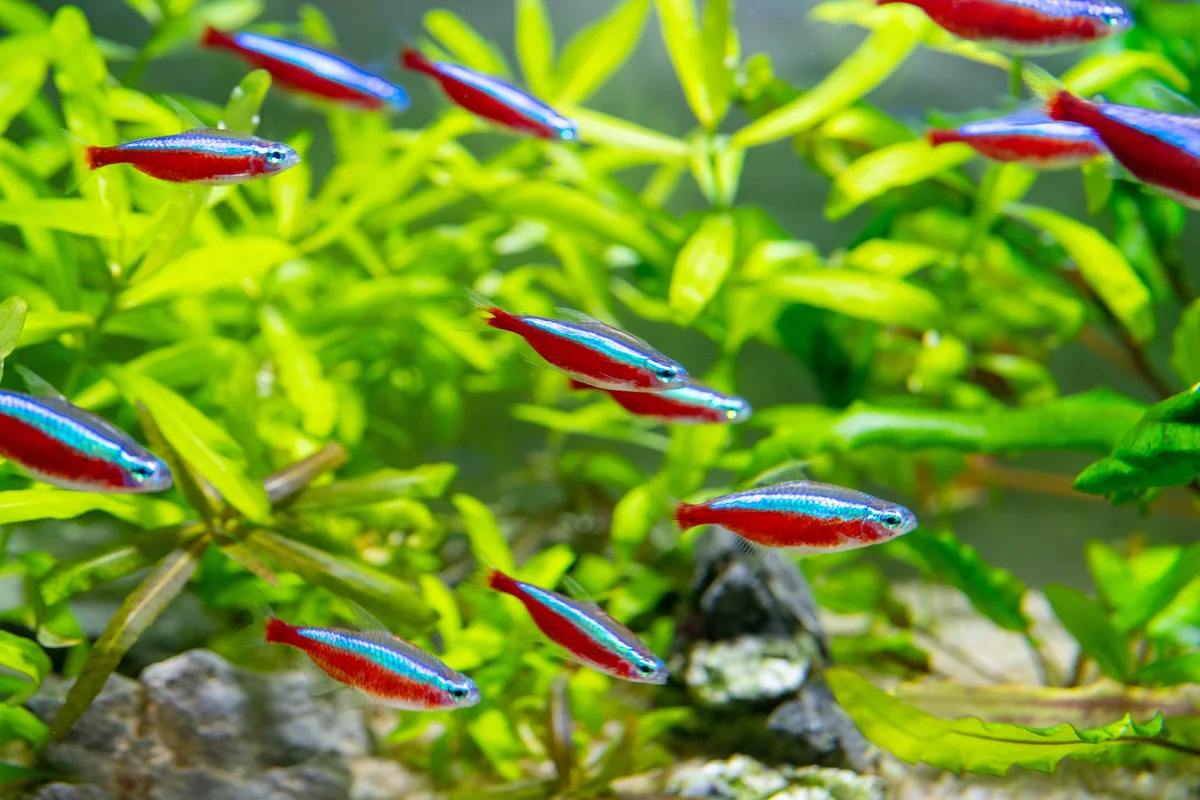
What neon tetras look like (and how to tell them apart from cardinals and green neons)
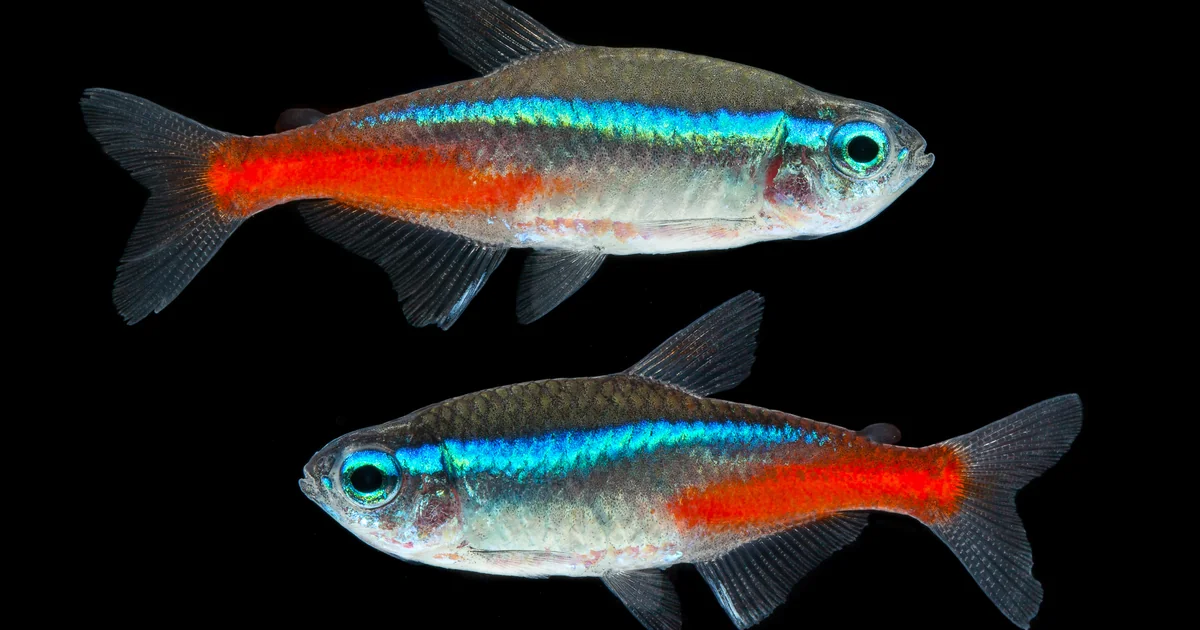
A neon tetra is a small, slim-bodied fish with two unmissable features: an iridescent blue-green stripe running from its eye to the base of its adipose fin, and a bright red stripe that covers only the back half of its body. That second feature is the one to memorize, because it’s how you separate a real neon from a cardinal tetra (whose red stripe runs the full body length).
The blue line above the red is structural, not pigment-based. It comes from light refracting off chromatophores in the skin, which is why neons look more brilliant under certain lighting and over dark substrate. In bright direct light over light-colored gravel, that same blue can look washed out. This isn’t disease, but it is something to keep in mind when you’re scaping a tank you actually want to look at.
Sexual dimorphism is subtle. Females are slightly larger and rounder in the belly when gravid, and the blue stripe on a female may bend slightly around her egg-filled abdomen, while males have a straighter, more linear stripe. Outside of breeding condition, you basically cannot sex them at the store.
The bigger ID problem is the genus. Paracheirodon contains three species sold side by side, and they’re not interchangeable.
Neon tetra vs cardinal tetra vs green neon: which one do you actually want?
This is the single most important comparison in this guide, because picking the wrong species for your setup is the upstream cause of a huge percentage of “my tetras keep dying” complaints. The three species look similar, get sold from adjacent tanks at the fish store, and have meaningfully different requirements.
| Trait | Neon (P. innesi) | Cardinal (P. axelrodi) | Green Neon (P. simulans) |
|---|---|---|---|
| Adult size | 1.5 in | 2.0-2.5 in | 1.0 in (smallest) |
| Red stripe | Rear half only | Full body length | Minimal red, dominant blue-green |
| Temperature | 70-77°F | 73-82°F | 75-82°F |
| pH | 6.0-7.5 | 5.0-7.0 | 5.0-7.0 (prefers <6.5) |
| Hardness | 1-10 dGH | 1-6 dGH | <5 dGH |
| Best for | Cooler community (74-76°F) | Warm community (discus, angelfish, rams) | Dedicated blackwater nano |
The practical translation: if you want a 78-82°F community tank with discus, angelfish, German blue rams, or anything else that prefers warmer water, you don’t want neons. You want cardinals. They handle the heat, they’re slightly larger and more visually striking, and the red goes all the way down the body. Neons in that same tank are technically alive but stressed, eat through their lifespan faster, and die earlier than they should.
If your tank is running 73-76°F with corydoras, harlequin rasboras, dwarf gouramis, or other cooler-end community fish, neons are the right call.
Green neons are the specialist option. They’re the smallest of the three (an inch fully grown), they need genuinely soft acidic water, and they’re best for dedicated blackwater nano tanks rather than mixed communities.
Neon tetra tank size and setup requirements
The minimum I’m willing to recommend is 15-20 gallons for a school of 8-10. You’ll see “10 gallons is fine” in older guides, and technically a small school will survive there, but neons are open-water swimmers and a 10-gallon footprint is too cramped for a proper school to express normal shoaling behavior. Footprint matters more than height for these fish. A long, shallow 20-gallon (the 30″ by 12″ footprint) is far better than a tall 20.
If you’re building this as a first tank, a complete beginner-friendly aquarium kit in the 15-20 gallon range solves most of the equipment-matching problems at once. If you’re building from scratch, the standard aquarium setup process applies: start with the tank cycled and stable before any neons go in.
For aesthetic and behavioral reasons, build the tank like a slice of the western Amazon. Driftwood, leaf litter, dim shaded zones, and a darker substrate all play to the species. The blue iridescence in their stripe is much more striking over dark substrate than over white sand or pale gravel.
Filtration
Neons aren’t high-current fish. They come from slow-moving blackwater streams, not riffles. A gentle hang-on-back or a sponge filter is ideal. Avoid powerheads and avoid setups where the filter return blasts across the open swimming area, because the school will spend its energy fighting the current instead of behaving naturally.
For a 15-20 gallon school tank, the right size small aquarium filter is one rated for slightly above your actual gallons. Slightly oversized filtration with a slower flow setting beats undersized filtration running flat-out.
Heating
Get an accurate adjustable heater in the 25-50 watt range and set it to 73-75°F. That’s a safe community midpoint that keeps neons in their preferred range and works for almost any cool-end community tankmate. Avoid preset heaters locked at 78°F, which will run your neons hot. A glass thermometer or digital probe in the tank is mandatory; heaters fail, sometimes silently, and a thermometer is the cheapest insurance you can buy.
Water conditions
| Parameter | Target |
|---|---|
| Temperature | 70-77°F (73-75°F is the sweet spot) |
| pH | 6.0-7.5 |
| GH | 1-10 dGH (soft preferred) |
| KH | 2-8 dKH |
| Ammonia (NH₃) | 0 ppm (always) |
| Nitrite (NO₂) | 0 ppm (always) |
| Nitrate (NO₃) | <20 ppm |
Neons tolerate a wider GH range than people often claim. If your tap water comes out at 8 dGH and a neutral pH, you don’t need to mess with RO water for a community tank. They’ll live just fine. The only time you need to soften water for neons is if you’re attempting to breed them, which is a different conversation entirely.
Substrate, plants, and lighting
Dark substrate makes the blue stripe pop. This isn’t aesthetic preference, it’s how the chromatophores in their skin behave: against a dark background, the iridescent layer reflects more visibly. Black sand or a dark planted tank substrate like aquasoil are both excellent. Pale gravel produces washed-out neons that look like a different fish.
For lighting, less is more. Neons live under a forest canopy in the wild, and they color up best under diffuse, lower-intensity light. Floating plants (water sprite, salvinia, frogbit) shade the upper water column and let the school cruise comfortably below. Driftwood and Indian almond (catappa) leaves leach tannins, which both stain the water amber and provide mild antimicrobial benefit. One catappa leaf per 5-10 gallons, replaced every 4-6 weeks, is the standard dosage.
Cycling and water chemistry: the part you can’t shortcut
Never add neons to an uncycled tank. Characoids generally are sensitive to ammonia and nitrite spikes, and while neons aren’t quite as fragile as some of their cousins, “fish-in cycling” with neons is a recipe for the exact die-off that drives people to give up the hobby.
A standard fishless cycle takes 4-6 weeks unaided. With seeded biological media from an established tank (10-20% of the new filter media taken from a friend’s working tank), you can compress that to 1-2 weeks. Bottled bacteria starters help too, though quality varies. The targets you’re waiting for are simple: ammonia at 0, nitrite at 0, and detectable nitrate. Test daily during cycling with a reliable liquid kit (the API Freshwater Master Test Kit is the standard for a reason).
Once cycled, weekly 25-30% water changes keep nitrates suppressed and replenish the trace minerals that get depleted over time. Skipping water changes is the slow killer in neon tanks: nitrates creep up, pH drifts, and by the time the school looks pale and lethargic, you’ve been running on a degraded tank for weeks.
What do neon tetras eat?
Diet basics
In the wild, neons are micro-predators. They pick zooplankton, tiny insect larvae, and bits of plant detritus out of the slow-moving blackwater they live in. Their mouths are small, so any food you offer needs to be sized appropriately. A standard tropical flake is fine if you crush it slightly between your fingers before dropping it in. Pellets need to be the smallest size you can find (Hikari Micro Pellets and similar tetra-specific formulations are designed for this).
A varied diet is what produces healthy, well-colored neons. Flake or micro-pellets as the staple, with frozen and live foods rotated in 2-3 times a week, keeps them in better shape than any single food alone.
Recommended foods
| Food | Type | Notes |
|---|---|---|
| Quality tropical flake | Staple | Crushed between fingers; floats long enough for school to feed at mid-water |
| Tetra-sized micro pellets | Staple | Slow-sinking variants work best for mid-water feeding |
| Frozen daphnia | Variety | Roughage; supports digestion; 1-2x weekly |
| Frozen bloodworms | Variety | High-protein treat; chop if pieces are larger than the fish’s mouth |
| Live or frozen baby brine shrimp | Conditioning | Excellent for breeding conditioning and color enhancement |
| Microworms | Conditioning | Live food; cheap to culture; useful for spawning prep |
For the staple, any of the well-reviewed tropical fish foods sized for tetras will work. The brand matters less than the freshness; a fresh container of a mid-tier flake beats an old container of a premium one.
How much, how often
Feed twice a day, only what the school finishes in two minutes. Anything left after two minutes is overfeeding, which translates directly into ammonia load on your filter and (eventually) into a water-quality crash that hits neons before it hits hardier tankmates.
Best neon tetra tank mates (and what to avoid)
Before you think about tank mates at all, get the school size right. The legacy “minimum of 6” is a survival floor, not a welfare target. The closely related cardinal tetra has documented stress-illness in groups under 10. The same general principle applies to neons: in groups of 4-6, they look pale, hide more, and individually drop off over months. In groups of 8-10+, they school confidently, color up properly, and live closer to their genetic lifespan.
Get the school established first. Then think about what else goes in the tank.
| Species | Compatibility | Notes |
|---|---|---|
| Bronze, panda, sterbai corydoras | Good | Bottom-dwellers in 6+; same temp range; ignore neons completely |
| Otocinclus | Good | Algae-eating peaceful schoolers; keep 6+; require established tank |
| Harlequin rasboras | Good | Same temp range; another peaceful schooler; visually contrasting |
| Ember tetras | Good | Smaller; bright orange; stay mid-water; same parameters |
| Cherry shrimp | Good | Adults are safe with neons; expect some shrimplet predation |
| Nerite snails | Good | Algae control; ignored by neons |
| Dwarf gourami | Caution | Usually peaceful; some individuals nip; many carry iridovirus from breeders |
| Peaceful livebearers (platies, endlers) | Caution | Behaviorally fine; livebearers prefer harder water than neons, parameter compromise |
| Bettas | Caution | Highly individual; aggressive bettas eat neons; tank must be 15+ gal heavily planted |
| Angelfish | Avoid | Adult angels eat adult neons; classic doomed pairing. Better angelfish tankmates exist. |
| Tiger barbs | Avoid | Notorious fin-nippers; will harass neons relentlessly |
| Serpae tetras | Avoid | Fin-nippers; same problem as tiger barbs |
| Larger cichlids (oscars, jack dempseys, etc.) | Avoid | Will eat the entire school in one sitting |
| Discus, German blue rams | Avoid | Behaviorally fine; require 80°F+, which shortens neon lifespan. Use cardinals. |
If you want a second mid-water schooler that complements neons, rummy nose tetras are an excellent choice. They school more tightly than neons, share similar parameters, and the contrast between the red-nosed rummies and the blue-and-red neons is genuinely stunning in a planted tank.
Common neon tetra diseases and how to treat them
Neon Tetra Disease (Pleistophora hyphessobryconis)
This is the disease that bears the species’ name, and it’s worth understanding clearly because it’s the one most beginner content either ignores or panics about. Neon Tetra Disease is caused by a microsporidian parasite, Pleistophora hyphessobryconis, which destroys muscle tissue from the inside out.
Symptoms appear gradually: the iridescent stripe loses brightness in patches, the body develops cyst-like white or pale areas under the skin, the fish swims restlessly or has trouble keeping up with the school, and over the course of days or weeks the fish wastes away and dies. The disease is sporadic across captive lines but documented across the species. There is no cure. Affected fish should be culled humanely (clove oil overdose is the standard method) to prevent transmission, and any equipment used in the tank should be disinfected before being used elsewhere.
The honest framing: it’s not so common that you should expect every batch of neons to develop it, but it’s common enough that you should know what it looks like and act decisively when you see it. Quarantining new arrivals is the single best defense.
Ich (white spot disease)
Ich (Ichthyophthirius multifiliis) is the most common visible disease in any tropical tank, and neons are not immune. Symptoms are unmistakable: small white salt-grain dots covering the body and fins, fish flashing against decor, lethargy. Treatment is heat (raise to 80°F gradually for 10-14 days, which shortens the parasite’s lifecycle) combined with either aquarium salt at 1 tsp per gallon or a commercial ich treatment. Continue treatment for at least 7 days after the last spot disappears.
For a deeper dive on identification and treatment, the white spots on fish guide covers the diagnostic flow in detail.
Color fading and stress
Pale, washed-out neons are a symptom, not a disease. The most common upstream causes are water-quality problems (especially ammonia or nitrite over 0.5 ppm, which fade color within 12-24 hours), social stress in undersized schools, lighting changes, or subclinical illness onset. Healthy fish recover their color within hours of the stressor being removed.
If your school looks faded, work the diagnostic in this order: test the water, count the school (under 8?), check for any aggressor in the tank, look for any visible signs of disease, and review whether you’ve changed lighting or substrate recently. Most cases resolve once the underlying issue is fixed. If you’ve ruled out everything else and they still look pale, the next concern is whether something subclinical is starting.
Bacterial and fungal infections
Fin rot and columnaris (mouth fungus) both show up in neons that have been chronically stressed by poor water quality. Fin rot looks like ragged, eroding fin edges, often with reddening at the base. Columnaris is a cottony white growth on the mouth, jaws, or body. Both respond to commercial antibacterial treatments, but the upstream fix is always water quality. A neon tank that keeps having outbreaks isn’t unlucky; it has a maintenance problem.
Prevention via quarantine
Chain-store neons are notorious for arriving with NTD, columnaris, or external parasites. The standard quarantine period for chain-store fish is 4 weeks in a separate cycled tank, observing for symptoms before introducing them to the display. A quarantine setup doesn’t have to be elaborate: a 10-gallon tank, a sponge filter that’s been cycling in your display tank, a heater, and bare-bottom substrate is enough.
If a quarantine setup is impractical, at minimum buy from a single source, observe the store tank for at least 5-10 minutes before purchase (look for any dead or dying fish, any white spots, any pale or hiding individuals), and use the proper acclimation method.
How to breed neon tetras at home
Breeding neon tetras is genuinely difficult. It’s not in the same league as breeding livebearers or even cichlids. The species spawns under very specific water chemistry, the eggs are photophobic, the parents eat their own eggs within hours, and the fry are too small to eat baby brine shrimp on day one. If you’ve never bred a fish before, neons are not the species to start on. If you have some experience and want a real project, here’s the protocol that actually works.
Why neon tetras are hard to breed: five-point pre-flight
Before you set up a thing, understand what you’re up against:
- Water chemistry is non-negotiable. Spawning requires pH 5.5-6.5, GH of 1-3, and KH of 0-2. Most municipal tap water is too hard for the eggs to fertilize. You’ll need RO/DI water, and you’ll need to remineralize it intentionally.
- Eggs are photophobic. Light kills them. The breeding tank has to be in complete darkness during egg incubation, with all sides covered.
- Parents eat eggs within hours. Tetras are aggressive egg-eaters. If you don’t remove the parents at first light after spawning, you’ll lose almost the entire spawn (typical survival without separation is around 5%).
- Fry mouths are smaller than 0.3 mm. They cannot eat baby brine shrimp on day one. Without infusoria or vinegar eels lined up in advance, fry starve in 3-5 days even though “food” is in the tank.
- Conditioning takes 2-3 weeks. You can’t grab a random pair off the shelf and expect a spawn. The breeders need to be conditioned with live and frozen foods until the females are visibly gravid.
Conditioning the breeders
Two to three weeks before you intend to spawn, separate males and females into different tanks if possible. Feed both groups heavily with live daphnia, frozen bloodworms, microworms, and live or frozen baby brine shrimp 2-3 times a day. The goal is females visibly plump along the lower belly, with the iridescent stripe slightly bent around their swollen abdomen. Males should be slim, with a straight, linear stripe.
Identifying mature breeders matters. Younger fish (under 9 months) often spawn poorly or produce infertile eggs. Adult fish in their second year of life are the most reliable breeders.
Setting up the breeding tank
A 5-10 gallon dedicated breeding tank is enough. The setup is purpose-built and looks nothing like a display tank.
- Bottom: bare glass, or a thin layer of glass marbles. Marbles let scattered eggs fall between them and out of parental reach.
- Water: RO/DI remineralized to GH 1-3 and KH 0-1. Use a GH-only remineralizer (Salty Shrimp Bee Shrimp Mineral GH+ is the cleanest option for this target; Seachem Equilibrium also works) so you don’t accidentally raise KH and buffer the pH out of range. Stain the water amber with Indian almond leaves, alder cones, or a small bag of boiled peat. The right RO/DI unit pays for itself if you’re going to do this seriously.
- Substrate for spawning: a clump of java moss, a yarn-based spawning mop, or a fine-leaved plant. The eggs are adhesive and will cling to whatever surface area you provide.
- Filtration: sponge filter only. No hang-on-back, no canister, no impeller. The flow has to be gentle enough that fry won’t be sucked in.
- Lighting: complete darkness during egg incubation. Cover all four sides of the tank with black construction paper or aquarium background. This is non-negotiable. Even ambient room light leaking in can kill the eggs overnight.
- Temperature: 73-75°F initially. Drop to 72-74°F when introducing the breeders to mimic the rainy-season trigger.
Cycle the tank, or seed it with a sponge filter that’s been running in another tank for at least 4-6 weeks. Test the water chemistry the day before introducing the breeders.
The spawn
Introduce a conditioned pair (or a trio of one female and two males) in the late afternoon or evening. The black-papered tank should be in a quiet area with no foot traffic. Spawning typically happens overnight or in the early morning, triggered by the first dim light reaching the tank.
A successful spawn produces roughly 50-150 adhesive eggs scattered across the moss, mop, or substrate. Eggs are tiny, transparent, and nearly impossible to see without looking carefully.
Remove the parents at first light. This is the single most-skipped step, and the reason most home breeding attempts produce zero fry. If the adults stay in the tank, they’ll eat almost every egg they find within hours. Move the breeders back to your conditioning tank.
Eggs hatch in 24-36 hours at 73-75°F. The hatched fry are nearly invisible and remain attached to the moss, mop, or glass for another 4-5 days while they absorb their yolk sacs. Free-swimming fry appear around day 5-6 post-spawn.
Fry rearing: the food ladder
This is where most home attempts collapse, because fry mouths are tiny and the food has to match. Here’s the staged feeding ladder that actually works:
| Days post-hatch | Food | Notes |
|---|---|---|
| 1-3 (yolk sac) | Do not feed | Yolk reserves only; feeding now rots in the water and crashes ammonia |
| 5-10 (free-swimming, mouth ≤0.3 mm) | Infusoria, green water, or commercial liquid fry food | Fry too small for anything else; without this stage they starve |
| 10-14 | Vinegar eels (50-75 µm) or microworms | Vinegar eels fit neon fry mouths better than microworms |
| 14-21 | Newly hatched baby brine shrimp (~450 µm) + vinegar eels in parallel | Some fry can handle BBS by day 14; smaller individuals still need vinegar eels |
| 21+ | BBS staple + powdered fry food (Hikari First Bites, Sera Micron) | Reintroduce dim light gradually; fry color stripe begins around 4-6 weeks |
Pre-establish your infusoria, microworm, and vinegar eel cultures at least 1-2 weeks before the expected spawn. Brine shrimp eggs and a cone-bottom hatchery should also be on hand. If you wait until the fry are free-swimming to start your cultures, you’ll be too late.
Common failure modes
- Tap water too hard: eggs are visible after spawning but never fertilize. The number-one failure. Fix: use RO/DI water and remineralize for soft conditions.
- Light leakage: eggs die overnight. Fix: cover the tank fully on all sides, including the top, and keep it in a room that doesn’t have ambient light bleeding in.
- Parents not removed: no fry survive. Fix: remove the breeders at first light, no exceptions.
- Wrong food size: visible fry, visible food, dying fry. Fix: stage your cultures in advance and use the food ladder above.
If you make it through to free-swimming fry on infusoria and vinegar eels, the rest of the project gets steadily easier. Surviving fry start showing the iridescent stripe around 4-6 weeks and look unmistakably like miniature neons by 8 weeks. By 3 months they can join a standard community tank.
Wild-caught vs captive-bred neons
Almost every neon tetra in the trade is captive-bred. Major commercial breeding operations in Hong Kong, Singapore, the Czech Republic, and Florida have been producing neons in industrial quantities for decades, and wild-caught P. innesi is uncommon in retail channels. (Cardinal tetras, by contrast, are still mostly wild-caught from the Rio Negro region; that’s the species you should ask about if wild sourcing matters to you.)
From a practical standpoint, this means neon tetras at your local fish store are essentially always farm-bred. Quality varies enormously between sources. The cheapest neons from chain stores often come from the largest, lowest-margin farms, where overcrowding and disease pressure are highest. Better neons from local fish stores or specialty breeders cost a couple of dollars more per fish and arrive significantly healthier.
Is a neon tetra right for your tank?
If you’re running a 73-76°F community tank with a 15-gallon footprint or larger, you have access to a properly cycled tank, you can commit to a school of 8-10 minimum, and you’re willing to do weekly water changes, then yes — neons are an excellent fish, and they’ll reward you with 5-8 years of the most iconic schooling display in the freshwater hobby.
If your tank runs warmer than 78°F, switch to cardinal tetras. They handle the heat, look similar but better, and pair beautifully with the warm-water fish (discus, angelfish, rams) that the temperature implies you’re keeping.
If you’re new to fishkeeping entirely, plan the substrate (a dark planted tank substrate if you want maximum color), pick the right tropical fish food sized for tetras, and consider rummy nose tetras as a complementary schooling species once your neons are established.
The fish itself isn’t difficult. The mistakes around it are. Get the temperature, the school size, and the water quality right, and the rest of neon tetra care is genuinely as easy as the SERP claims it is.
Neon tetra care FAQs
How long do neon tetras live?
5-8 years is the typical range for neon tetras kept under proper conditions. Most home neons die earlier than that, usually within 1-3 years, and the leading cause is being kept at temperatures above their range. A neon tetra in a 73-75°F tank with stable water quality and a proper school will live well into its fifth year. The same fish at 80°F has a metabolism running faster than it was designed for, and you’ll see them die off long before they hit five.
Can neon tetras live with bettas?
Sometimes, but it depends entirely on the individual betta’s temperament and the tank size. The general rules: tank should be 15 gallons or larger, heavily planted with multiple lines of sight broken up, and the betta should be introduced after the neon school is already established. Some bettas ignore the school completely. Others see them as targets and will pick them off one at a time over weeks. There’s no way to predict which kind of betta you have until you try, so always have a backup plan (a separate tank, or a willing rehome) before mixing them.
Why are my neon tetras losing color?
Color loss is a symptom with several possible upstream causes. Test water first: ammonia or nitrite over 0.5 ppm fades color within 12-24 hours. If water is clean, count the school: under 8, the fish are chronically stressed, which fades color over days. Check for any aggressor in the tank. Consider whether you’ve changed lighting, substrate, or water source recently. If everything checks out and they’re still pale, the next concern is whether subclinical illness (like early Neon Tetra Disease) is starting. Healthy neons recover their color within hours of any stressor being removed; if they don’t bounce back, something underlying is going on.
Will neon tetras breed in a community tank?
Essentially never. Successful neon spawning requires very specific water chemistry (pH 5.5-6.5, GH 1-3, soft water), complete darkness during egg incubation, and removal of the parents within hours of spawning. Community tanks have none of those conditions. You may occasionally see eggs scattered onto plants in a soft-water community, but the parents and other tankmates will eat them within an hour, and any survivors will starve when they hatch because community tanks don’t have the right first foods. Real breeding requires a dedicated blackwater breeder tank set up exactly as described in the breeding section above.