You walked out of the fish store with three adorable 1.5-inch clown loaches in a bag, and somewhere on the drive home it hit you: nobody really explained what proper clown loach care actually looks like over the next two decades. The orange-and-black striped fish darting around the display tank were irresistible. The sales associate mentioned snail control. What they probably did not mention is that those finger-sized juveniles will grow to a foot long, demand a 6-foot tank, refuse to thrive without a school of five or more, and quite possibly outlive your dog.
Clown loaches (Chromobotia macracanthus) are one of the most charismatic fish in the freshwater hobby. They are also one of the most consistently mis-sold. The standard pet-store framing positions them as beginner-friendly snail-eaters, which is technically true for the first year. By year three, the math changes completely. This guide walks through what realistic clown loach care looks like once you account for adult size, schooling biology, scaleless medication sensitivity, and a 15-to-25-year lifespan that occasionally stretches past 30.
Disclosure: This post contains affiliate links. If you purchase through a link on this page, we may earn a small commission at no extra cost to you. We only recommend products we’d use in our own tanks.
Clown Loach Care at a Glance
Before we dig into the details, here is the snapshot view. If any of these numbers surprise you, the rest of this guide is going to explain why they matter.
| Attribute | Detail |
|---|---|
| Common Names | Clown loach, tiger botia |
| Scientific Name | Chromobotia macracanthus |
| Family | Botiidae |
| Origin | Sumatra and Borneo (Indonesia) |
| Adult Size | 12 in (30 cm); some specimens up to 16 in |
| Lifespan | 15-25+ years; documented over 25 |
| Tank Size | 125-150 gal for an adult school of 5-6 |
| Temperature | 77-86 °F (25-30 °C) |
| pH | 6.0-7.5 |
| Temperament | Peaceful schooler; obligate group of 5+ |
| Diet | Omnivore; dedicated snail predator |
| Care Level | Intermediate |
What Clown Loaches Look Like (and the Spines You Can’t See)
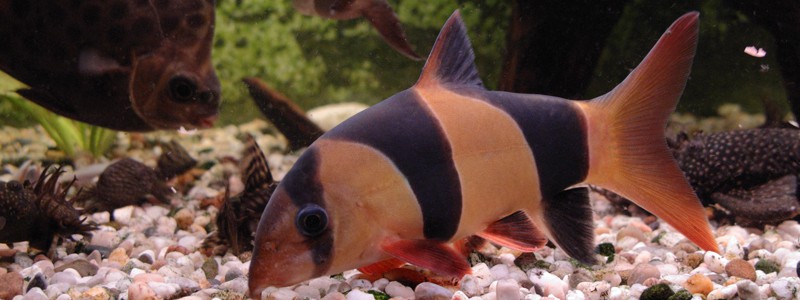
Clown loaches are immediately recognizable, even to people who have never owned an aquarium. The body is bright orange to orange-red, with three broad black vertical bands: one through the eye, one across the mid-body, and one across the caudal peduncle near the tail. Fins are orange to reddish. The body profile is long and laterally compressed, arched high at the dorsal fin, with a pointed snout that is reported to carry four pairs of sensory barbels for foraging.
No two clown loaches are identical. Stripe width, intensity, and the exact placement of the bands vary between individuals. In a group of six, you can usually pick out specific fish by pattern within a few days.
Now for the part that is easier to overlook. Clown loaches are typically considered essentially scaleless, with skin that is reported to be far thinner and more permeable than the average community fish. This single anatomical detail drives almost every medication decision later in the article. Treatments that are routine for tetras can be dangerous for loaches.
Sexual dimorphism in clown loaches is subtle and only reliable in mature adults that are several years old. Juveniles cannot be reliably sexed at all. If you want a balanced school, buy at least five or six and let nature sort it out.
Are There Different Clown Loach Color Morphs?
Here is the honest answer: no, not really. Unlike bettas, guppies, or angelfish, the clown loach has not been line-bred into a parade of trade color morphs. There are no established albino, gold, or longfin forms in the hobby. Every clown loach you see in a store is the same wild-type orange-and-black pattern, just with the individual stripe variation discussed above.
| Form | Notes |
|---|---|
| Standard orange-and-black | The only form in trade. Individual stripe variation gives a school visual diversity without separate varieties. |
| C. macracantha (spelling variant) | Same species. A minor spelling variant of Chromobotia macracanthus that occasionally appears in older trade listings; not a separate fish. |
If you see a listing for an “albino clown loach” or “long-fin clown loach,” treat it with skepticism. It is almost certainly a different species being sold under a misleading name, or a juvenile of another botiid loach.
Clown Loach Tank Size and Setup Requirements
This is where a lot of older care guides go wrong. The internet is full of “75-gallon minimum” recommendations for clown loaches, and that number is below modern consensus. It might work for the first few years while the fish are still juveniles, but it will not work for adults.
Here is the realistic timeline. Juveniles grow at roughly 1-2 inches per year and reach adult size over 5 to 10 years. A 55-to-75-gallon tank can house a small group through about three years and six inches of growth. After that, you need a much larger setup. The current consensus for an adult school of five or six fish is typically around 125 to 150 gallons, which usually means a 6-foot tank.
Length matters more than total volume. A 6-foot tank with a 150-gallon capacity is a far better adult home than a tall column-style aquarium with the same gallonage. Clown loaches are active mid-water and bottom swimmers; they need horizontal swimming runs, not vertical real estate.
Substrate
Clown loaches root around the substrate constantly, using those four pairs of barbels to find food. Coarse gravel damages those sensitive barbels over time. Fine pool filter sand, or any smooth aquarium-grade sand, is the right choice. For a deeper look at substrate options, our aquarium sand substrate guide covers what works for various species.
One mechanical caveat: sand and filters do not always get along. Hang-on-back filters are the most vulnerable because the intake leads directly to the impeller. Canister filters are largely protected because the media basket sits between the intake and the rotor. For a sand-substrate clown loach tank, a canister filter with a raised intake and a pre-filter sponge is the safe bet.
Hardscape and Lighting
Driftwood, smooth rock caves, and PVC pipe shelters are all good. Clown loaches are nervous fish that need places to disappear when stressed. Provide enough caves that every fish in the school can claim a refuge, plus a few extra. Open swimming space along the front of the tank, dense cover along the back, and dim-to-moderate lighting suits them well.
Filtration
A 125-to-150-gallon tank with active schooling fish needs strong filtration. Aim for 8 to 10 times tank turnover per hour, split between a large canister and supplemental flow if needed. Gentle flow zones for resting and stronger zones for foraging give the school options.
Clown Loach Water Parameters: Temperature, pH, Hardness
Clown loaches come from soft, warm Indonesian rivers, and they appreciate parameters that reflect that origin.
| Parameter | Range |
|---|---|
| Temperature | 77-86 °F (25-30 °C); upper end preferred |
| pH | 6.0-7.5 |
| GH | 5-15 dGH |
| Ammonia / Nitrite | 0 ppm |
| Nitrate | Typically under 20 ppm |
One detail is worth flagging specifically. Aquarium Co-op recommends keeping clown loaches in the warmer end of their range, around 82 to 86 °F, with their team personally running tanks at 85-86 °F to suppress ich. The reason is biological: higher temperatures accelerate the ich parasite’s lifecycle, which sounds counterintuitive but actually works in your favor.
For now, the practical takeaway is: lean toward the upper end of the temperature range during normal operation, and make sure your heater is reliable. Temperature swings stress clown loaches and can trigger latent ich. A high-quality heater is not an upgrade for this species; it is a baseline requirement.
Stability matters as much as the specific numbers. Multiple sources confirm clown loaches are sensitive to parameter swings. Consistent weekly water changes (25-30%) and matched-temperature replacement water are far more important than chasing a perfect pH reading.
What Do Clown Loaches Eat?
Clown loaches are omnivores with a heavy preference for protein. In the wild they sift through substrate for invertebrates, small crustaceans, and plant matter. In the aquarium, they accept almost any sinking food.
A sensible staple rotation includes high-quality sinking pellets, frozen bloodworms, frozen brine shrimp, and occasional blanched vegetables like zucchini, cucumber, or spinach. Feed once or twice a day in amounts the school can finish in two or three minutes. Hidden uneaten food is a bigger problem in a clown loach tank than in most setups, because the fish forage at night and can stash leftovers under hardscape.
| Food | Frequency | Notes |
|---|---|---|
| Sinking pellets | Daily staple | Choose a quality omnivore or community formula |
| Frozen bloodworms / brine shrimp | 2-3x weekly | Encourages natural foraging behavior |
| Blanched vegetables | 1-2x weekly | Zucchini, cucumber, spinach; weigh down with a vegetable clip |
| Pest snails | Opportunistic | Active predation; not a sustainable control method alone |
Clown Loach Diet and Snails: Setting Expectations
The clown loach’s reputation as a pest-snail controller is genuine, not folklore. Multiple keeper and forum sources confirm the behavior is dedicated and active rather than opportunistic. Clown loaches actively hunt ramshorn snails, bladder snails, and Malaysian trumpet snails. The predation extends to larger snails as well, including mystery snails, which is something to keep in mind if you want to mix species.
However, there are honest caveats to the snail-control angle. First, clown loaches will outgrow most tanks where a snail problem would warrant biological control in the first place; a 20-gallon tank with a bladder snail explosion is not solved by adding a fish that needs 150 gallons. Second, snail populations rebound fast. If you have an outbreak, the root cause is usually overfeeding and excess organic matter, and fixing that matters more than adding predators. For smaller tanks, an assassin snail is usually the better answer.
Best Clown Loach Tank Mates (and What to Avoid)
Clown loaches are peaceful in adequately sized tanks, but their schooling needs and adult dimensions narrow the compatibility list. The first rule is non-negotiable: keep at least five, and ideally six or more. Solo specimens and trios decline. Isolated clown loaches stop eating, fade in color, and often die within months. This is not a quirky preference; it is biology. They are obligate social fish.
| Species | Compatibility | Notes |
|---|---|---|
| Silver Dollars | Good | Peaceful mid-water schoolers; share size and tank-footprint needs |
| Congo Tetras | Good | Large enough to avoid being seen as food; soft-water tolerant |
| Plecos (bristlenose, common) | Good | Share substrate without direct competition; both thrive in large tanks |
| Bala Sharks | Good | Both need 6-foot tanks; peaceful active schoolers |
| Severums / Blue Acaras | Caution | Peaceful cichlids that work in 150+ gal; can become territorial during breeding |
| Tiger Barbs | Caution | Mutual fin-nipping risk; keep 8+ barbs and watch behavior closely |
| Small Tetras (neon, ember) | Caution | Adult loaches may view very small fish as prey; better in juvenile-only setups |
| Aggressive Cichlids (Oscars, Jack Dempseys) | Avoid | Will bully and stress the school; stressed loaches get ich faster |
| Shrimp and Small Invertebrates | Avoid | Will be eaten alongside pest snails; same predatory instinct |
| Solo Clown Loach | Avoid | Single specimens decline; never keep fewer than five |
Clown Loach Lifespan and Growth: A Multi-Decade Commitment
Most articles bury this section. We are putting it front and center because the lifespan and growth math is what reframes the whole purchase decision. Clown loaches are not a five-year fish. Well-cared-for specimens typically live 15 to 25 years, and documented individuals have crossed the 25-year mark. By any reasonable measure, this is a multi-decade pet.
The growth side of the equation is what catches new owners off guard. Clown loaches grow slowly, at roughly 1 to 2 inches per year. A 1.5-inch juvenile reaches 6 inches in about three years, then keeps going. Adult size lands around 12 inches over 5 to 10 years, with some specimens topping out closer to 16 inches.
For example, a tank that “seems fine” in year two often becomes obviously undersized in year four or five. The slow growth is deceptive, not forgiving. Owners who buy at 1.5 inches into a 55-gallon tank rarely realize they have miscalculated until the fish are noticeably cramped.
| Age | Approximate Size | Tank Reality |
|---|---|---|
| Purchase (juvenile) | 1.5 in | 55-75 gal workable for a small group |
| Year 3 | 5-6 in | Upgrade approaching; juvenile tank near its limit |
| Year 5-7 | 8-10 in | 125-150 gal required; 6-foot tank only honest answer |
| Year 10+ | 12 in adult size | Mature school in long-term display setup |
| Year 15-25+ | 12-16 in | Long-term residents; lifetime ownership territory |
The takeaway is simple. Before you buy clown loaches, think about where you will be in 15 to 20 years. Will you still have space for a 6-foot tank? If the honest answer is no, this is not the right species. If the answer is yes, you are signing up for one of the most rewarding long-term relationships in the freshwater hobby.
Common Clown Loach Diseases and How to Treat Them
This is the section that justifies the “intermediate” care-level rating. Clown loaches are notoriously prone to ich, and they cannot tolerate the standard treatment protocols at full strength because of their scaleless construction. Getting this part right is the difference between a school that thrives for decades and a tank that crashes within weeks of purchase.
Quarantine every new arrival for four weeks minimum. This is not optional for clown loaches. Transport stress almost always triggers ich, and adding new fish directly to your display tank will infect every other inhabitant. For the broader picture, our guide on setting up a quarantine tank covers the basics.
| Condition | Symptoms | Treatment |
|---|---|---|
| Ich (white spot) | Pinpoint white “salt grain” spots; flashing against decor; rapid breathing | Heat to 86 °F over 24 hrs; half-dose Ich-X; daily 25% water changes for 14 days. Avoid copper. |
| Columnaris | Whitish-gray flat “saddle” patches on back; rapid progression | Lower temperature to ~75 °F; gram-negative antibiotic. Do NOT raise heat. |
| Fin Rot | Eroding ragged fin edges; reddening at the base | Improve water quality; commercial antifungal/antibacterial; remove fin-nippers |
| Bacterial Gill Disease | Rapid gill movement; surface gulping; reduced appetite | Improve water quality; broad-spectrum antibiotic; increase aeration |
| Skinny Disease (internal parasites) | Weight loss despite eating; sunken belly; white stringy feces | Levamisole or fenbendazole per package; treat the whole tank |
Clown Loach Ich Treatment: The Lifecycle That Explains the Protocol
Ich (Ichthyophthirius multifiliis) is a ciliated protozoan parasite with three life stages, and understanding the stages is what makes the treatment protocol make sense. The trophont is the visible white spot stage, where the parasite is embedded under the fish’s skin. It is protected by the epidermis and is invulnerable to medication. The tomont is the encysted stage on the substrate, dividing into hundreds of daughter cells. The theront is the free-swimming infective stage, and it is the only stage that medication can actually kill.
Here is the key insight: temperature controls how fast the parasite cycles through these stages. At 78 °F, the full cycle takes about 7 days. At 86 °F, it takes 3-4 days. Raising the temperature does not kill ich directly; it forces the parasite to drop off the fish and enter the medication-vulnerable theront stage faster. That is why the standard salt-and-heat protocol works.
For clown loaches, the protocol needs scaleless-fish adjustments. Raise the temperature gradually to 86 °F over 24 hours. Use Ich-X at half the standard dose (roughly 5 mL per 20 gallons rather than per 10 gallons), redosed every 24 hours after a one-third water change. Avoid copper-based treatments entirely; scaleless fish absorb copper too readily. Continue the protocol for 14 days at 86 °F, even after spots disappear, to catch every cycle turn.
A Note on Activated Carbon
Remove activated carbon from your filter before dosing any medication. Carbon absorbs medication and renders it ineffective within hours. This is the single most common reason new fishkeepers report that “the ich medication did not work.” Restart filtration with new carbon only after the full treatment course is complete.
How to Breed Clown Loaches at Home (Spoiler: You Can’t)
Natural spawning of clown loaches in home aquaria is essentially undocumented. Every clown loach in the trade is either wild-caught from Sumatra and Borneo or produced at commercial Southeast Asian farms using hormone induction. There is no realistic home-breeding pathway.
Practical Fishkeeping is explicit that hormone-induced spawning “should only be attempted by trained professionals.” For home keepers, the practical takeaway is straightforward: treat clown loaches as a long-term display species. The breeding behavior that drives most home fish reproduction (pair bonding, courtship, egg-laying in caves or on substrate) does not occur in standard home setups for this species.
Clown Loach Care FAQs
How long do clown loaches live?
Well-cared-for clown loaches typically live 15 to 25 years, and documented specimens have lived past 25. This is a multi-decade commitment, which is one of the reasons the species is not a great impulse purchase.
Why do clown loaches need to be in groups?
Clown loaches are obligate social fish. Solo specimens and trios typically stop eating, fade in color, and decline over weeks or months. Keep at least five, and ideally six or more, to see normal feeding behavior, color, and activity levels.
Are clown loaches good for snail control?
They are active and dedicated snail predators that eat ramshorn, bladder, and Malaysian trumpet snails. However, they grow to a foot long and need a 125-150 gallon tank, which is more aquarium than most snail problems justify. For smaller tanks, assassin snails are usually a better solution.
Do clown loaches have venom in their spines?
No. The retractable sub-ocular spines beneath each eye can cause painful puncture wounds and snag net mesh, but they are not venomous. Handle clown loaches with a fine-mesh net or a plastic container rather than coarse netting.
How fast do clown loaches grow?
Slowly. About 1 to 2 inches per year, reaching adult size of around 12 inches over 5 to 10 years. The slow growth is one reason undersized tanks “seem fine” for years before the problem becomes obvious.
Is a Clown Loach Right for Your Tank?
Here is the honest summary. Proper clown loach care means a 125-to-150-gallon tank, a school of five or more, fine sand substrate, strong filtration, warm stable water, and the patience to nurse a scaleless species through inevitable ich outbreaks using half-dose protocols. It also means a 15-to-25-year relationship with the fish.
If you have the space, the commitment, and the long-term plan, clown loaches are some of the most rewarding freshwater fish in the hobby. They develop individual personalities, recognize their keepers, school in a way that feels almost coordinated, and live long enough to genuinely become pets rather than tank decoration.
If you do not have a 6-foot tank, consider the alternatives. Yoyo loaches top out around 5-6 inches and work in a 55-gallon tank. Kuhli loaches stay small enough for a 20-gallon setup and have plenty of personality of their own. The fish in the store at 1.5 inches is genuinely cute. The fish in your tank a decade later is genuinely large. Plan for both.