Disclosure: This post contains affiliate links. If you purchase through a link on this page, we may earn a small commission at no extra cost to you. We only recommend products we’d use on our own tanks.
Your filter is the single most important piece of equipment on your tank. It handles mechanical filtration (removing debris), biological filtration (converting toxic ammonia into less harmful nitrate), and in many cases chemical filtration (removing dissolved chemicals through activated carbon or specialized media). Without adequate filtration, water quality deteriorates within hours and fish health follows shortly after.
I’ve run hang-on-back filters, canister filters, and sponge filters across multiple tanks over the years. Each type has a place, and the best aquarium filter for your setup depends on your tank size, fish load, budget, and whether you’re running a single display tank or managing several tanks at once. There’s no single “best” filter for everyone, but there is a best filter for your specific situation.
This guide covers the 6 best aquarium filters that cover every common scenario, along with how to choose the right filter type and size for your tank. I’ve kept the list tight on purpose – these are the picks I’d actually recommend, not a padded list of 10+ products to fill a page.
Quick Comparison
| Filter | Type | Tank Size | Flow Rate | Wattage | Best For |
|---|---|---|---|---|---|
| AquaClear 70 | HOB | Up to 70 gal | 300 GPH | ~6W | Best overall HOB. Proven reliable. |
| Fluval 407 | Canister | Up to 100 gal | 383 GPH | ~15W | Best canister for medium tanks. |
| Fluval FX6 | Canister | Up to 400 gal | 925 GPH | ~43W | Large tanks and heavy bioloads. |
| Seachem Tidal 55 | HOB | Up to 55 gal | 250 GPH | ~6W | Best modern HOB design. Self-priming. |
| Marineland Penguin 350 | HOB | Up to 70 gal | 350 GPH | ~8W | Budget HOB with Bio-Wheel. |
| Sponge Filter | Air-driven | Up to 40 gal | Gentle | ~3-5W | Multiple tanks, breeding, backup power. |
How to Choose the Right Filter
Filter Type by Tank Size
The type of filter you need depends primarily on your tank size and fish load. Here’s a straightforward guide:
| Tank Size | Best Filter Type | Why |
|---|---|---|
| Under 10 gallons | Sponge filter or small HOB | Gentle flow won’t overwhelm small fish. Sponge filters are ideal for bettas and shrimp tanks. |
| 10-55 gallons | Hang-on-back (HOB) | Easy to maintain, good filtration, affordable. The sweet spot for most community tanks. |
| 55-150 gallons | Canister filter | More media capacity and flow rate than HOBs. Hidden under the stand for a cleaner look. |
| 150+ gallons | Large canister or sump | Heavy bioloads need serious filtration. Consider running multiple filters for redundancy. |
| Multiple tanks | Sponge filters + central air pump | One air pump can run sponge filters on 4-6 tanks. Cheapest and most energy-efficient way to filter a fishroom. |
Flow Rate
The general rule is your filter should turn over the entire tank volume 4 times per hour. For a 30-gallon tank, that means a filter rated for at least 120 GPH. For a 55-gallon tank, 220 GPH minimum. Keep in mind that manufacturers list maximum flow rates under ideal conditions – real-world flow is typically 15-25% lower once media is loaded and hoses are connected. Size up rather than down.
Filtration Types
Mechanical filtration physically removes particles from the water using foam pads, filter floss, or sponges. This is what keeps your water visually clear. Coarser media catches large debris; finer media polishes the water.
Biological filtration is the most important type. Beneficial bacteria colonize porous media like ceramic rings, bio-balls, or sponge and convert toxic ammonia (from fish waste) into nitrite, then into much less harmful nitrate. This is the nitrogen cycle, and it’s what keeps your fish alive between water changes. Every filter needs biological filtration capacity – the more surface area for bacteria, the better.
Chemical filtration uses media like activated carbon to remove dissolved chemicals, odors, and discoloration from the water. It’s not essential for most tanks but useful for removing medications after treatment, clearing tannins from driftwood, or polishing water in display tanks. Carbon should be replaced monthly as it becomes saturated.
Energy Efficiency and Backup Power
This is something most filter guides ignore, but it matters: how much power your filter draws affects how long it can run on a battery backup during a power outage. A sponge filter running on a small air pump draws 3-5 watts. A hang-on-back filter draws 6-10 watts. A large canister filter can draw 15-45 watts. On a typical UPS battery backup, a sponge filter can run for days while a canister might only last a few hours. If you live in an area prone to power outages, this is worth factoring into your filter choice. See our aquarium battery backup guide for more on keeping your tank alive during outages.
The Best Aquarium Filters
1. AquaClear Power Filter – Best Overall HOB
TOP PICK
The AquaClear has been the go-to hang-on-back filter in the aquarium hobby for decades, and for good reason. It’s available in 5 sizes (20, 30, 50, 70, and 110) covering tanks from 5 gallons up to 110 gallons. The AquaClear 70 model handles tanks up to 70 gallons with a 300 GPH flow rate and is the most popular size for community tanks.

What makes the AquaClear better than most HOBs is its design. Instead of using disposable cartridges that force you to throw away your biological media every month, it uses three separate media baskets: a foam insert for mechanical filtration, activated carbon for chemical filtration, and BioMax ceramic rings for biological filtration. You can replace each one individually, which means you never lose your entire bacterial colony during maintenance. You can also swap in whatever media you prefer – I’ve run Seachem Matrix and Purigen in mine without any issues.
The flow rate is adjustable, which is useful for tanks with fish that prefer calmer water like bettas or for slowing flow during feeding. It runs quietly once primed, though the motor doesn’t always self-prime after power outages – you may need to manually fill the filter basket with water to restart it. This is the one real downside and worth keeping in mind if you lose power frequently.
I’ve used AquaClear filters on multiple tanks and they consistently deliver. The media lasts for years before needing replacement, maintenance is straightforward, and the build quality holds up over time. For most fishkeepers running tanks under 70 gallons, this is where I’d start.
Available sizes: AquaClear 20 (up to 20 gal, 100 GPH) | AquaClear 30 (up to 30 gal, 150 GPH) | AquaClear 50 (up to 50 gal, 200 GPH) | AquaClear 70 (up to 70 gal, 300 GPH) | AquaClear 110 (up to 110 gal, 500 GPH)
2. Fluval 407 Canister Filter – Best Canister for Medium Tanks
The Fluval 07 series is the updated version of the popular 06 line, and the 407 is the sweet spot for tanks between 50-100 gallons. It pushes 383 GPH through a square canister design that holds more media than comparably sized round canisters. The 07 series is about 25% quieter than its predecessor, and Fluval improved the priming mechanism and seal design to reduce the microbubble issues that plagued some earlier models.

The filter uses stackable media trays that you can arrange however you want. It ships with foam pads, BioMax rings, and carbon, but you’re not locked into any specific configuration. Each tray is individually removable for maintenance without disturbing the others. The intake strainer is clog-resistant, and the quick-disconnect valves let you remove the canister for cleaning without draining hoses.
I’ve run Fluval canisters on tanks ranging from 55 gallons to over 100 gallons. They’re workhorses. The initial setup takes longer than a HOB filter and you need space below the tank for the canister, but the tradeoff is significantly more media capacity, better flow, and a cleaner look since nothing hangs on the back of your tank. For planted tanks or larger community setups, a canister is the upgrade that makes the biggest difference in water clarity.
Full 07 series: Fluval 107 (up to 30 gal, 145 GPH) | Fluval 207 (up to 45 gal, 206 GPH) | Fluval 307 (up to 70 gal, 303 GPH) | Fluval 407 (up to 100 gal, 383 GPH)
3. Fluval FX6 Canister Filter – Best for Large Tanks
If you’re keeping large predator fish like peacock bass, arowanas, or running a tank over 100 gallons, the FX6 is the standard. It’s rated for tanks up to 400 gallons with a massive 925 GPH flow rate and 1.5 gallons of media capacity split across three large baskets. This is serious filtration for serious tanks.
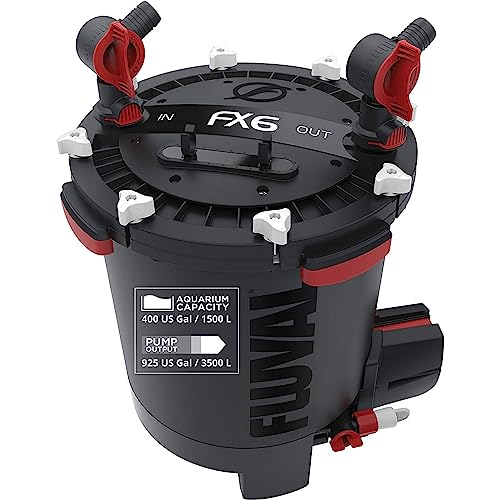
The FX6 has a built-in self-priming system – just add water, plug it in, and it handles the rest. It also includes a programmed maintenance reminder that pauses the motor briefly every 24 hours during the first run to purge trapped air, then shifts to monthly reminders. The multi-directional output nozzles let you position the canister anywhere relative to the tank.
The downside is size and weight. The FX6 is heavy when full and awkward to move for cleaning. The powerful intake can catch small or slow-moving fish if the strainer isn’t properly secured. And at around 43 watts, it draws significantly more power than smaller filters, which matters if you’re running on battery backup during outages. But for large tanks, there’s nothing else that matches its combination of flow rate, media capacity, and build quality at this price point.
Also available: Fluval FX4 (up to 250 gal, 700 GPH) for slightly smaller setups.
4. Seachem Tidal 55 – Best Modern HOB Design
The Seachem Tidal is a newer HOB filter that solves several problems older designs still have. The biggest improvement: it self-primes after power outages. If you’ve ever come home to a dead AquaClear after a brief power flicker, you’ll appreciate this. The Tidal’s pump sits inside the filter rather than relying on a siphon, which means it restarts automatically every time.
The water flow design is also smarter. Water enters through the bottom of the filter basket and flows upward through the media before returning to the tank. This means water has to pass through all your media rather than finding a path around it, which is a problem with many back-to-front HOB designs. A built-in surface skimmer pulls oils and film off the water surface, and there’s a blue maintenance indicator that pops up when the media is getting clogged and needs cleaning.
The filter basket holds any media you want – no proprietary cartridges. It ships with Seachem’s Matrix bio-media, which is excellent. The basket is removable and snaps into the filter lid for drip-free transport to a sink for cleaning. The Tidal runs at only about 6 watts, making it very efficient for its output.
If I were setting up a new tank under 55 gallons today, I’d strongly consider the Tidal over the AquaClear specifically because of the self-priming feature. The AquaClear still has a slight edge in media capacity for its size, but the Tidal’s design improvements make it the better choice for anyone who travels or lives in areas with unreliable power.
Available sizes: Tidal 35 (up to 35 gal) | Tidal 55 (up to 55 gal) | Tidal 75 (up to 75 gal) | Tidal 110 (up to 110 gal)
5. Marineland Penguin 350 Bio-Wheel – Best Budget HOB
BUDGET PICK
The Marineland Penguin has been a staple budget filter for years. It comes in 4 sizes (100, 150, 200, and 350 GPH) covering tanks from 20 to 70 gallons. The 350 model is the best value – it has dual cartridge slots and dual Bio-Wheels, giving you more filtration than the smaller models at a modest price increase.
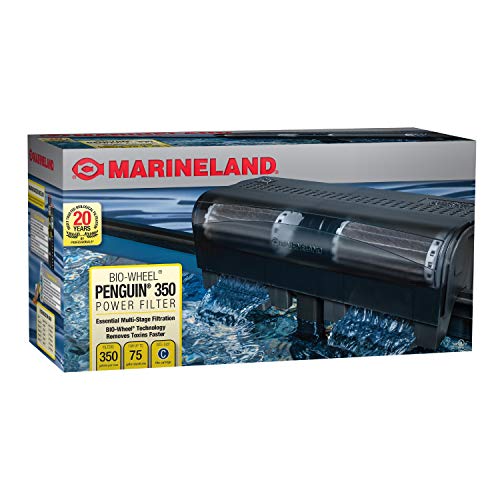
The signature feature is the Bio-Wheel – a rotating cylinder that sits at the filter’s water outlet and provides a large surface area for beneficial bacteria while exposing them to air, which promotes aerobic bacteria growth. It’s a clever design that adds biological filtration beyond what the cartridges provide. The wheel should never be replaced unless it’s physically falling apart, even when you swap cartridges.
I’ve used the Marineland Penguin and it does the job reliably. The main downside is that it uses disposable cartridges rather than reusable media baskets like the AquaClear. This means ongoing replacement costs and you lose some biological filtration each time you swap a cartridge. You can work around this by staggering cartridge replacements (one at a time on the 350 model) and never replacing both at once. The flow rate is adjustable, cartridges can be swapped without turning off the filter, and the unit is easy to set up right out of the box.
It can be a little noisy for the first few days after setup or after a cartridge change while air works its way out of the system. Once settled, it’s reasonably quiet. For the price, it’s hard to beat if you’re on a budget or setting up a tank for a kid.
Available sizes: Penguin 100 (up to 20 gal) | Penguin 150 (up to 30 gal) | Penguin 200 (up to 50 gal) | Penguin 350 (up to 70 gal)
6. Sponge Filter – Best for Multiple Tanks and Backup Power
BEST FOR FISHROOMS
Sponge filters don’t get the respect they deserve. They’re the most underrated filtration option in the hobby, and for fishkeepers running multiple tanks, they’re arguably the smartest choice you can make. A single air pump can power sponge filters across 4-6 tanks simultaneously through an airline splitter, which makes them by far the most cost-effective way to filter a fishroom.

Here’s where sponge filters really shine: energy efficiency. A sponge filter runs on a small air pump drawing just 3-5 watts. Compare that to 15-45 watts for a canister filter. On a battery backup during a power outage, a sponge filter can keep running for days while a canister might drain your UPS in a few hours. If you keep expensive or sensitive fish, having sponge filters as your primary or backup filtration means your fish keep breathing even when the power doesn’t come back quickly.
Sponge filters provide excellent biological and mechanical filtration. The sponge surface area is massive relative to the filter’s size, making it a great home for beneficial bacteria. The gentle flow makes them ideal for breeding tanks, fry tanks, shrimp tanks, and betta tanks where strong currents would stress the inhabitants. They don’t provide chemical filtration (no carbon), but for most freshwater setups that’s not a dealbreaker.
The downsides are cosmetic. Sponge filters sit inside the tank and aren’t pretty. They won’t polish water to the crystal-clear level a canister filter can. And for tanks over 40 gallons with a heavy fish load, a sponge filter alone may not provide enough filtration – though you can always run one alongside a HOB or canister for redundancy.
I recommend sponge filters to anyone running more than one tank. The cost savings on electricity, replacement media, and equipment add up fast. They’re also the filter I recommend keeping on hand even if you use a canister or HOB as your primary – if your main filter fails, a cycled sponge filter can keep your tank alive while you troubleshoot or get a replacement.
Types of Aquarium Filters Explained
Hang-On-Back (HOB) Filters
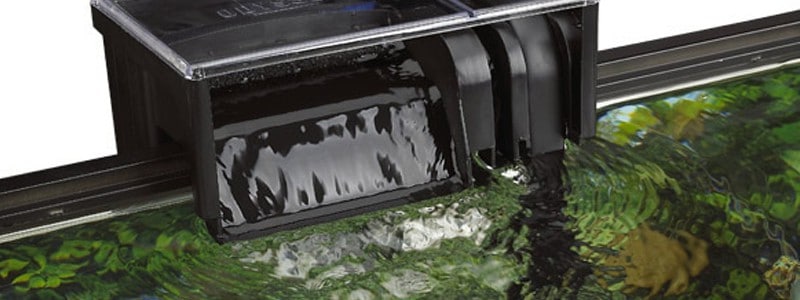
HOB filters hang on the outside of the tank with an intake tube that reaches into the water. They’re the most popular filter type for good reason: easy to install, easy to maintain, and effective for most tank sizes. Water is drawn up through the intake, passed through filter media in the hanging compartment, and returned to the tank as a waterfall. Most HOBs provide all three types of filtration and come in a wide range of sizes. The main limitation is media capacity – for tanks over 55-70 gallons, most HOBs can’t keep up with the bioload and a canister becomes the better choice.
Canister Filters
Canister filters sit outside and below the tank, connected by intake and output hoses. Water is drawn into a sealed, pressurized canister where it passes through multiple trays of filter media before being returned to the tank. Canisters offer the most media capacity of any filter type, excellent flow rates, and a clean aesthetic since nothing hangs on the back of your tank. The tradeoff is higher cost, more complex setup, and more involved maintenance. They’re the standard choice for tanks 55 gallons and up, planted tanks, and predator tanks with heavy bioloads.
Sponge Filters
Sponge filters sit inside the tank and are powered by an external air pump. Air bubbles rise through a central tube, drawing water through the sponge by suction. They provide biological and mechanical filtration with extremely low power consumption and no moving parts inside the filter itself. The gentle flow makes them perfect for fry, shrimp, and fish that don’t tolerate strong currents. The downside is that they sit inside the tank, taking up space and not winning any beauty contests. For a fishroom with multiple tanks, though, nothing beats the cost and efficiency of sponge filters running off a single air pump.
Internal Filters
Internal filters mount inside the tank, typically with suction cups against the glass. They use a small pump to move water through built-in media compartments. They’re compact and work well for small tanks under 20 gallons, but limited media capacity makes them unsuitable for larger setups. They’re often included with starter tank kits.
Sump Filters
A sump is essentially a secondary tank that sits below your main display tank. Water overflows into the sump, passes through various filter media compartments, and is pumped back up to the display. Sumps offer the most filtration capacity of any system, add water volume to your setup (which stabilizes water chemistry), and can house heaters and other equipment out of sight. They’re the gold standard for reef tanks and large freshwater setups, but they require plumbing, a drilled tank or overflow box, and more space beneath the stand.
Frequently Asked Questions
How often should I clean my fish tank filter?
Most filters need a light cleaning every 2-4 weeks. Signs it’s time: reduced water flow, visible debris buildup on sponges, or a weaker outflow. Messy fish like goldfish and cichlids or heavily stocked tanks need more frequent cleaning. Always rinse filter media in old tank water, never tap water – the chlorine in tap water will kill the beneficial bacteria your tank depends on.
Do I need to replace all filter media at once?
Never replace all media at the same time. Your biological media houses the bacteria that keep your fish alive. Replace one piece at a time and stagger replacements over several weeks so the bacteria population can recover. Mechanical media like foam and sponges can be rinsed and reused for months. Biological media like ceramic rings should be reused until they’re physically falling apart. Chemical media like activated carbon is the only type that genuinely needs regular replacement – about once a month.
Why do small tanks need a filter?
Small tanks actually need filtration more than large tanks. In a 5-gallon tank, there’s very little water to dilute ammonia from fish waste. Toxin levels can spike to dangerous concentrations in just a day or two. A small sponge filter or nano hang-on-back filter keeps the water safe so you’re not doing daily water changes to keep your fish alive.
What’s the best filter media?
For most tanks, a combination of foam or sponge (mechanical) and ceramic rings or Matrix (biological) covers everything you need. Foam is cheap, long-lasting, and effective for both mechanical and biological filtration. Ceramic rings and bio-media like Seachem Matrix have massive surface area for bacteria colonization. Activated carbon is useful for polishing water and removing odors but isn’t essential for routine use. Products like Seachem Purigen are excellent for display tanks where crystal-clear water matters.
Can I use a new filter immediately?
You can install and run a new filter right away, but it won’t have beneficial bacteria yet. New filters need 2-6 weeks to cycle before they can fully process fish waste. Speed this up by transferring media from an established filter, using bottled bacteria like Seachem Stability, or running the new filter alongside an existing one for a few weeks before removing the old one.
Which is better: HOB, canister, or sponge filter?
It depends on your setup. Sponge filters are cheapest, most energy-efficient, and ideal for small tanks, breeding, shrimp, and multi-tank fishrooms. HOB filters are the best balance of performance, ease of maintenance, and price for most community tanks up to 70 gallons. Canister filters offer the most filtration power and media capacity, best for tanks over 55 gallons, planted tanks, or tanks with messy fish that produce heavy waste. Many experienced fishkeepers run a canister or HOB as their primary filter with a sponge filter as backup.
Do all fish produce the same amount of waste?
Not even close. Goldfish, large cichlids, oscars, and plecos produce far more waste than small community fish like tetras or rasboras. A 55-gallon tank with 20 neon tetras needs much less filtration than a 55-gallon tank with one oscar. If you’re keeping messy species, size your filter for a tank larger than what you actually have – for example, use a filter rated for 75 gallons on a 55-gallon oscar tank.
How much electricity does an aquarium filter use?
Sponge filters (via air pump) use about 3-5 watts. Small HOB filters use 5-8 watts. Large HOBs use 8-12 watts. Canister filters range from 10-45 watts depending on size. For comparison, a 150-watt heater uses far more power than any filter. Filter electricity costs are minimal – even a large canister running 24/7 costs only a few dollars per month. The bigger consideration is backup power: low-wattage filters last much longer on battery backup during power outages.
Should I run my filter 24/7?
Yes, always. Filters should run continuously. The beneficial bacteria in your filter need constant water flow and oxygen to survive. Turning your filter off for even a few hours can start killing bacteria, and if the filter is off long enough (4+ hours), the stagnant water inside the canister or filter body can become toxic. When you turn it back on, that toxic water gets pumped into your tank. The only time to turn off a filter is during maintenance, and even then keep it brief.
Final Thoughts
For most fishkeepers, the AquaClear Power Filter is the best place to start. It’s proven, reliable, versatile, and gives you full control over your filter media. If you want a modern upgrade with self-priming and a smarter design, the Seachem Tidal is the one to look at. For tanks over 55 gallons or setups with messy fish, step up to the Fluval 407 canister. And if you’re running multiple tanks or want the most power-efficient setup possible, build around sponge filters with a quality air pump.
Whatever you choose, the best filter is one that’s properly sized for your tank and maintained regularly. A cheap filter that you clean every two weeks will outperform an expensive canister that you neglect for months.