
Disclosure: This post contains affiliate links. If you purchase through a link on this page, we may earn a small commission at no extra cost to you. We only recommend products we’d use in our own tanks.
The Dinosaur Bichir is one of the oldest living fish species on the planet. Dating back to the Cretaceous period over 60 million years ago, this fish has survived virtually unchanged while the dinosaurs it lived alongside went extinct. It can breathe air through a primitive lung, walk on land using its pectoral fins, and survive outside water for extended periods as long as its skin stays moist.
Despite its exotic appearance, the Dinosaur Bichir is a surprisingly manageable fish to keep. It’s hardy, tolerant of a range of water conditions, and not particularly aggressive toward tankmates it can’t swallow. The main challenges are its adult size (which demands a large tank), its carnivorous diet, and its talent for jumping out of uncovered aquariums.
This guide covers everything you need to keep a Dinosaur Bichir healthy and thriving: tank setup, diet, compatible tankmates, common health issues, and breeding. Whether you’re considering your first bichir or troubleshooting an existing setup, this is written to give you practical, experience-based information.
Quick Stats
| Attribute | Details |
|---|---|
| Common Names | Dinosaur Bichir, Senegal Bichir, Dinosaur Eel, Swamp Dragon, Dragon Fish |
| Scientific Name | Polypterus senegalus |
| Family | Polypteridae |
| Origin | Africa (Nile basin, Senegal River, Lake Chad, West African rivers and floodplains) |
| Adult Size | 12-18 in (30-46 cm) in captivity; up to 28 in (70 cm) in the wild |
| Growth Rate | Slow – approximately 2-3 cm per month |
| Lifespan | 15-20 years with proper care |
| Tank Size | 90+ gallons minimum (4 feet long or longer) |
| Temperature | 75-82°F (24-28°C) |
| pH | 6.5-7.5 |
| Hardness | 8-12 dGH |
| Temperament | Semi-aggressive, nocturnal bottom-dweller |
| Diet | Carnivore (live, frozen, sinking pellets) |
| Difficulty | Intermediate |
Species Overview
The Dinosaur Bichir (Polypterus senegalus) is a freshwater fish native to the rivers, lakes, swamps, and floodplains of Africa. First described in Egypt over 200 years ago by French naturalist E. Geoffroy Saint-Hilaire, the name Polypterus translates to “many fins,” referring to the distinctive row of serrated dorsal finlets running along their back.
Though often called a “Dinosaur Eel,” this species is unrelated to eels. Bichirs are unique enough to occupy their own family (Polypteridae) and represent one of the most primitive groups of ray-finned fish still alive today. Their origins trace back to the Cretaceous period, and their body plan has remained largely unchanged for tens of millions of years.
In the wild, Dinosaur Bichirs inhabit heavily vegetated, slow-moving water systems where they use murky conditions as cover to ambush prey. They rely almost entirely on scent to hunt, as their eyesight is poor. Their thick, armor-like ganoid scales protect them from injury, and their modified swim bladder functions as a primitive lung, allowing them to gulp air from the surface. This adaptation lets them survive in oxygen-depleted waters and even outside of water for extended periods, as long as their skin stays moist. In their native range, bichirs are common enough to occasionally turn up in roadside ditches after flooding.
Appearance
Dinosaur Bichirs have a long, cylindrical body covered in thick, diamond-shaped ganoid scales. Most specimens are grey, beige, or olive-brown on top with a lighter white or cream-colored belly. Juveniles sometimes show faint horizontal banding that fades with age. The head is broad and flat with pronounced teeth, wide iridescent eyes, and a pair of protruding tubular nostrils used for detecting scent. A series of 8-11 spiny dorsal finlets runs along the back, and two paddle-like pectoral fins sit behind the gills, which the fish uses for locomotion – giving it a distinctive “walking” movement along the substrate.
Dinosaur Bichir Lifespan and Size
Dinosaur Bichirs are a long-term commitment. With proper care, they can live 15-20 years in captivity. Some keepers have reported specimens exceeding 20 years in well-maintained setups.
Juvenile bichirs from pet stores are usually 4-6 inches (10-15 cm). They grow slowly, roughly 2-3 cm per month, and take several years to reach their full adult size. In captivity, most Dinosaur Bichirs max out around 12-18 inches (30-46 cm), though this depends heavily on tank size, diet quality, and overall care. Wild specimens can exceed 28 inches (70 cm).
The slow growth rate means you have time to plan your tank upgrade, but don’t make the mistake of starting in a tank that’s too small and assuming you’ll upgrade later. Stunted growth from cramped conditions is one of the most common issues with captive bichirs and can shorten their lifespan significantly.
Types of Bichir
The Dinosaur Bichir has two recognized subspecies:
P.s. senegalus: The more commonly available subspecies. Juveniles display three horizontal bands that fade as the fish matures. The upper jaw is slightly longer than the lower jaw, and coloration is brownish-grey to olive on the dorsal surface with a white belly. This fish has 8-11 dorsal finlets.
P.s. meridionalis: A larger subspecies that can reach up to 110 cm (43 inches) in the wild and 80 cm (32 inches) in captivity. Coloration is similar olive-grey but the upper and lower jaws are approximately equal in length. Individuals usually have 9-10 dorsal finlets.
Beyond the Dinosaur Bichir, several other Polypterus species are popular in the hobby:
| Species | Max Size | Temperament | Notes |
|---|---|---|---|
| Ornate Bichir | 24 in (60 cm) | More aggressive | Most visually striking species but very shy during the day. Grows larger than the Dinosaur Bichir. |
| Saddled Bichir | 30 in (75 cm) | Semi-aggressive | Large species best kept solo or in very big tanks. Slow swimmer, spends most time foraging. |
| Barred Bichir | 17 in (43 cm) | Peaceful | Native to the Congo River. Spends majority of time hiding in caves and crevices. |
| Rope Fish (Reed Fish) | 15 in (38 cm) | Peaceful | Also called Snakefish. Nocturnal predator that hunts anything under 3 inches. |
| Albino Bichir | 12-18 in (30-46 cm) | Semi-aggressive | A color morph of the Dinosaur Bichir. White body with red eyes. Care is identical. |
Dinosaur Bichir Tank Setup
Tank Size
The minimum tank size for an adult Dinosaur Bichir is 90 gallons (340 liters). More important than volume is footprint – bichirs are bottom-dwellers that need floor space more than water depth. A tank at least 4 feet long and 18 inches wide is ideal. Shallower, wider tanks are better than tall, narrow ones.
If you’re keeping multiple bichirs or housing them with large tankmates, plan for 125-180 gallons. If you need to check the volume of your current tank, use our aquarium volume calculator.
Water Conditions
Dinosaur Bichirs tolerate a fairly wide range of water parameters, but consistency matters more than hitting exact numbers. Aim for a temperature of 75-82°F (24-28°C), pH between 6.5 and 7.5, and hardness of 8-12 dGH.
One detail most care guides miss: bichirs prefer low water flow. In the wild, they inhabit slow-moving or still water. Strong filter output directed across the bottom of the tank will stress them. Point your filter outflow toward the surface or use a spray bar to diffuse the current. If you’re running a canister filter (recommended for tanks this size), check our guide to the best canister filters for options that let you adjust flow rate.
Filtration
Bichirs are messy carnivores. Their high-protein diet produces more ammonia than typical community fish, and uneaten food decays quickly. A canister filter rated for at least 1.5x your tank volume is the minimum. Many bichir keepers run two filters or pair a canister with a sponge filter for additional biological filtration. Weekly water changes of 25-30% are essential to keep nitrate levels manageable.
Substrate and Decorations
Use soft aquarium sand as the substrate. Bichirs spend most of their time on the bottom, and rough gravel can irritate their belly and damage their fins as they drag themselves along. Sand is also easier to clean since waste sits on top rather than falling between gaps.
Decorate with plenty of hiding spots. Caves made from smooth rocks, large pieces of driftwood or bogwood, and ceramic tubes all work well. Bichirs need dark, enclosed spaces to feel secure during the day. Without adequate hiding places, they become stressed and more prone to illness. Java Fern and Java Moss are good plant choices as they’re hardy enough to survive in a large predator tank. Avoid sharp-edged decorations that could damage their thick but not indestructible scales.
Lighting
Bichirs are nocturnal and prefer dim lighting. Bright lights during the day will keep them hidden and inactive. If you want to observe your bichir’s natural behavior, consider installing a blue “moonlight” LED that runs for a few hours each evening. This simulates twilight conditions and encourages them to come out and explore without causing stress.
Dinosaur Bichir Diet and Feeding
What They Eat
In the wild, Dinosaur Bichirs are ambush predators that eat crustaceans, small fish, aquatic insects, worms, and amphibians. They rely almost entirely on scent to locate food due to their poor eyesight.
In captivity, they’re not picky. You can feed them shrimp, prawns, mussels, silversides, earthworms, bloodworms, and other meaty foods. They’ll accept both live and frozen options. However, the most practical long-term diet is a high-quality sinking carnivore pellet supplemented with occasional frozen or live foods for variety.
Recommended Food
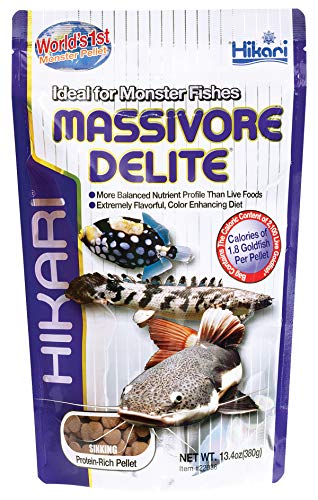
The pellet I recommend for Dinosaur Bichirs is Hikari Massivore Delite. It’s specifically designed for large carnivorous fish, sinks quickly to where bichirs feed, and makes it easy to wean them off live food. Another benefit is that it doesn’t cloud your water the way some cheaper pellets do. If your bichir doesn’t accept pellets right away, try starving them for 5-7 days and then offering the pellet. Most bichirs will take to it after a short training period.
Feeding Schedule and Tips
Feed adult Dinosaur Bichirs once daily, after the lights are off. They’re night predators and will rarely eat with the lights on. Offer only what they can consume in 2-3 minutes and remove any uneaten food promptly. Their high-protein diet produces more waste than typical fish food, so leftover food will spike ammonia and nitrate levels quickly.
Juveniles can be fed twice daily to support their growth. As a general rule, once a bichir reaches about 8 inches, switch to once-daily feeding. Overfeeding is a more common problem than underfeeding with this species. High-quality pellets are less likely to cause organ issues and constipation than cheaper alternatives or an all-live-food diet. Still, make it a habit to remove any uneaten food after each feeding.
Dinosaur Bichir Tank Mates
Dinosaur Bichirs are carnivorous predators, so tankmate selection requires some care. The basic rule: if it fits in a bichir’s mouth, it will get eaten. Any fish under 3 inches is at risk. That said, bichirs are not particularly aggressive toward fish they can’t swallow. They’re slow swimmers that mostly ignore tankmates of similar or larger size. Occasional nipping does happen but is usually a result of poor eyesight rather than aggression.
Avoid housing them with very aggressive species like large cichlids (Jaguar, Red Devil) or snakeheads, as these can injure or stress the bichir. Also avoid very active mid-water swimmers that might outcompete the bichir for food during feeding time.
| Category | Examples | Compatibility | Notes |
|---|---|---|---|
| Large Peaceful Fish | Angelfish, Silver Dollars, Large Gouramis | Good | Calm, similar size, won’t be eaten. Silver Dollars are especially good as they occupy the mid-water column. |
| Robust Bottom Dwellers | Plecos, Synodontis Catfish, Clown Loach | Good | Share bottom space well. Provide extra hiding spots so both species have their own territory. |
| Semi-Aggressive Large Fish | Datnoids, Oscars, Arowana, Large Barbs | Caution | Works in big tanks (125+ gallons). Ensure similar size and monitor for aggression, especially with Oscars. |
| Oddballs | Knifefish, Stingrays, Rope Fish | Caution | Possible in very large setups. Rope Fish and bichirs are natural companions but need ample space. |
| Other Bichirs | Other Polypterus species | Caution | Can cohabitate in large tanks with plenty of hides. Match sizes closely and monitor for fin nipping. |
| Small Community Fish | Guppies, Neon Tetras, Rasboras, Corydoras | Avoid | Will be eaten. Bichirs are opportunistic predators and will hunt anything that fits in their mouth. |
| Aggressive Predators | Jaguar Cichlids, Red Devils, Snakeheads | Avoid | Too aggressive. High risk of injury or chronic stress to the bichir. |
| Invertebrates | Shrimp, Small Snails | Avoid | Shrimp will always be eaten. Large Mystery Snails sometimes survive but there’s no guarantee. |
General Behavior
Dinosaur Bichirs spend most of the day resting on the substrate or hiding in caves. They become noticeably more active after dark, slowly patrolling the bottom of the tank and occasionally darting to the surface to gulp air. This surface breathing is normal and not a sign of low oxygen. You’ll also see them “walking” along the bottom using their pectoral fins, which is one of the most distinctive and entertaining behaviors in the fishkeeping hobby.
They are not schooling fish but tolerate conspecifics well in large tanks. Occasional displays of raised dorsal finlets are normal dominance behavior and rarely escalate to real aggression.
Common Health Issues
Dinosaur Bichirs are one of the hardier species in the hobby, but they’re not immune to health problems. Most issues stem from poor water quality or introducing wild-caught specimens without proper quarantine.
Macrogyrodactylus polypteri (Bichir-Specific Parasite)
This is the single most important health concern for bichir keepers, and most generic care guides barely mention it. Macrogyrodactylus polypteri is a skin fluke (monogenean trematode) that specifically targets Polypterus species. These parasites look like tiny hair-like threads attached to the skin, fins, and gills. In the wild, a bichir might carry 6-9 of these worms without issue. In aquarium conditions, infestations can explode to hundreds or even thousands of worms per fish, which is lethal without treatment.
Symptoms include rubbing against surfaces (flashing), rolling, thrashing, and visible fine thread-like worms on the body. Wild-caught bichirs are especially prone to carrying this parasite.
Cloudy Eyes
One of the most common issues in captive bichirs. This is almost always caused by poor water quality. If your bichir develops a cloudy or milky film over one or both eyes, test your water immediately and perform a large water change. In most cases, cloudy eyes will clear up within a few days once water quality is restored. If it persists, it could indicate a bacterial infection that requires separate treatment.
Ich (White Spot Disease)
Bichirs can contract ich, though they’re more resistant to it than most tropical fish thanks to their thick ganoid scales. Symptoms include white spots on the body and gills, rubbing against surfaces, and twitching. They usually respond well to heat treatment (raising temperature to 86°F for 10-14 days) combined with aquarium salt. If using medication, dose carefully and at reduced rates, as bichirs can be sensitive to certain chemicals.
General Health Tips
Perform 25-30% water changes every 1-2 weeks and test water quality regularly. Keep ammonia and nitrite at zero, and nitrate below 40 ppm. Don’t overfeed, as food waste from a high-protein diet degrades water quality fast. Feed high-quality foods to reduce the risk of constipation and organ issues. And remember that parasites and bacteria can hitchhike in on new tankmates, live food, plants, and decorations, so quarantine anything new before adding it to an established bichir tank.
When treating a sick bichir, best practice is to move it to a separate hospital tank without substrate or decorations. This makes treatment more effective and prevents medications from disrupting your main tank’s biological filtration. Note that activated carbon in your filter will absorb many medications, so remove it during treatment.
Breeding Dinosaur Bichirs
Breeding Dinosaur Bichirs in captivity is rare and difficult. Most specimens sold in pet stores are wild-caught from Africa, where they are widespread and common. Captive breeding does occur occasionally but requires very specific conditions that are hard to replicate in a home aquarium.
Sexing juveniles is virtually impossible. In adults, males can be identified by their thicker, wider anal fin compared to the more slender anal fin of females. Females tend to be slightly larger overall when fully mature.
In the wild, breeding is triggered by the onset of the rainy season, which brings cooler water temperatures and changes in water chemistry. Keepers who have successfully bred bichirs report simulating this by gradually lowering the water temperature by a few degrees over several weeks, increasing water changes, and softening the water. The male courts the female with nudging behavior, and eggs are deposited in dense vegetation. Fry are tiny and require live foods like baby brine shrimp from the start.
If you’re interested in breeding, start with a proven pair in a dedicated breeding tank of at least 90 gallons with plenty of fine-leaved plants or spawning mops. Be prepared for a long process with no guarantee of success.
Frequently Asked Questions
Can Dinosaur Bichirs live with Oscars?
Yes, but with caution. Oscars can be territorial and aggressive, especially during feeding. This pairing works best in tanks of 125 gallons or more where both fish have space to establish their own territory. Make sure the bichir has hiding spots the Oscar can’t access, and watch for signs of aggression during the first few weeks.
Why does my bichir keep going to the surface?
This is completely normal. Bichirs have a modified swim bladder that functions as a primitive lung, and they periodically gulp air from the surface. This is natural behavior, not a sign of low oxygen. You’ll see it more frequently at night when they’re most active. However, if your bichir is constantly at the surface and appears distressed, check your water parameters.
How long can a Dinosaur Bichir survive out of water?
Bichirs can survive outside of water for extended periods as long as their skin remains moist – potentially several hours. In the wild, they’ve been known to move between water sources over land using their pectoral fins. However, this doesn’t mean it’s safe. A bichir that jumps from your tank is at serious risk of injury from the fall and dehydration. Always keep a tightly sealed lid on the tank.
Do Dinosaur Bichirs need air access?
Yes. Because bichirs regularly breathe air from the surface, they need unobstructed access to the water’s surface. Don’t fill the tank all the way to the lid – leave a gap of 1-2 inches between the waterline and the cover. Avoid covering the entire surface with floating plants as this can make it harder for them to reach air.
My bichir won’t eat pellets. What should I do?
This is common with newly acquired bichirs, especially wild-caught specimens. Try fasting them for 5-7 days, then offering a high-quality sinking pellet like Hikari Massivore Delite after lights-out. Most bichirs will accept pellets once they’re hungry enough. You can also try soaking the pellet in garlic guard or tank water to release more scent. If they still refuse, alternate between pellets and frozen foods like bloodworms or mysis shrimp, gradually reducing the frozen food over time.
Is a Dinosaur Bichir right for beginners?
Dinosaur Bichirs are rated as intermediate, but they’re manageable for dedicated beginners willing to invest in the right setup. The main barriers are the large tank requirement (90+ gallons), the need for a secure lid, and the long lifespan commitment (15-20 years). If you can provide those basics, the day-to-day care is straightforward. They’re hardy, tolerant of a range of water conditions, and don’t require specialized water chemistry.
Final Thoughts
The Dinosaur Bichir is one of the most unique freshwater fish you can keep. It’s a living fossil with prehistoric looks, fascinating behavior, and a surprisingly manageable care profile. As long as you provide a spacious tank with a secure lid, plenty of hiding spots, a high-protein diet, and clean water, this species will thrive in your aquarium for years to come.
The biggest mistakes new bichir keepers make are underestimating the tank size needed, leaving gaps in the lid, and skipping quarantine on wild-caught specimens. Get those three things right and you’ll have a hardy, charismatic fish that’s unlike anything else in the hobby.